|
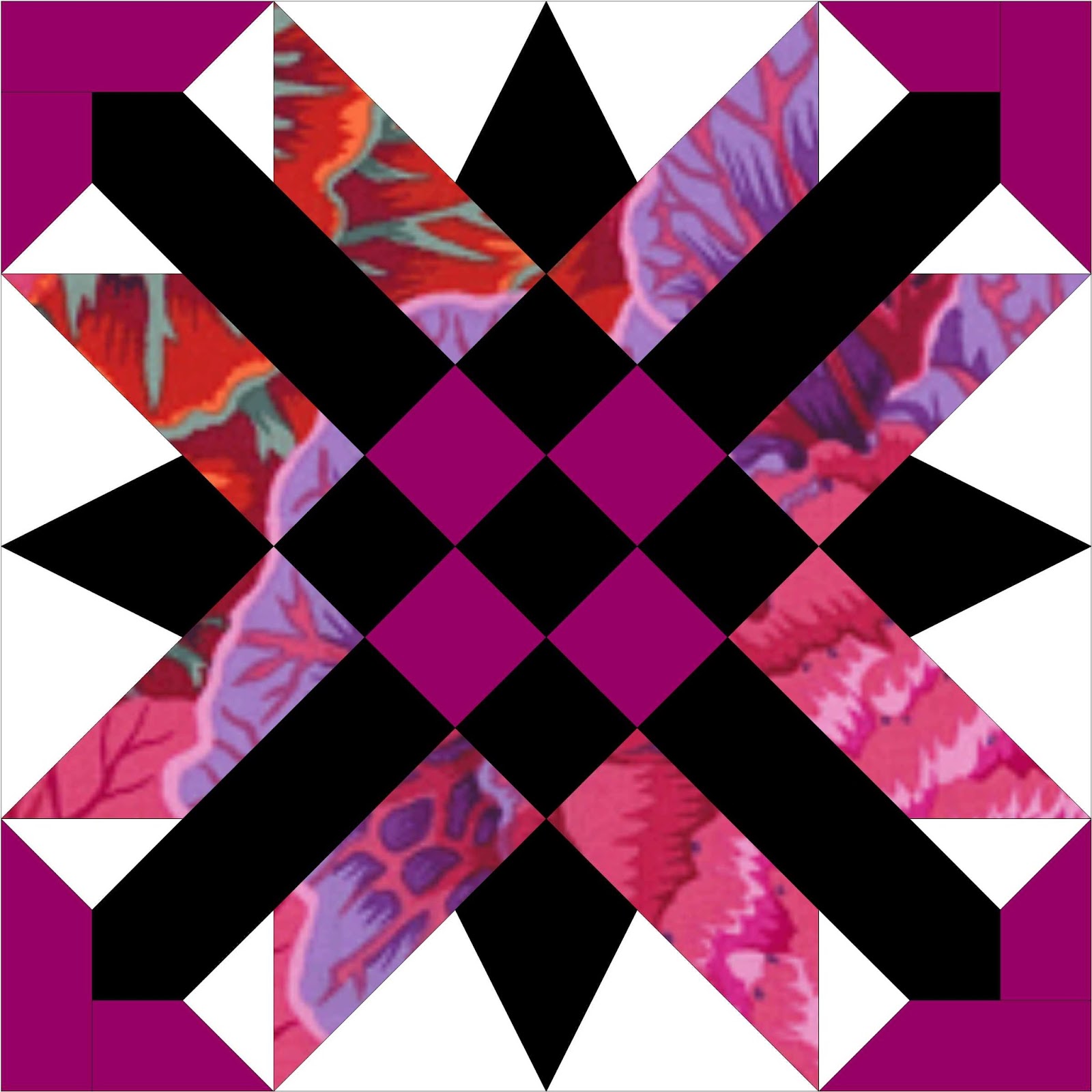
| Alice Block #3, Version 1 |
The 6" blocks in the 1930s Farmer's Wife sampler quilt are complex and time consuming to piece. I don't want to spend a lot of time putting a block together only to step back and look at the finished block and hate it. I know a lot of quilters will precut fabric pieces without seam allowances and lay them out like a mosaic to preview how their fabric choices will look together in a block, but that wastes fabric since you have to cut all new pieces with seam allowances for your block. Another option is to print out several line drawings of the block and test out different colored schemes with colored pencils, but it's difficult to match your fabric values and prints accurately. However, none of that is necessary if you use EQ7 quilt design software to preview your fabric combos.
 |
| Alice Block #3, Version 2 |
With Block #3 "Alice," I created a 1-block quilt in EQ7 and set the block size to 6" x 6". It's important that your block size is correct because EQ7 will use that information to accurately scale your fabric print (so that you are accurately seeing how that print will look cut up into the actual size patches in your block). I did a search in the block library for "Alice" and came up with a block that was very similar to the Alice block in the 1930s Farmer's Wife book. I just had to edit the block in the block worktable, removing a couple of seam lines and adding a few additional seam lines at the corners of the block.You can even rotate your fabric within your block patches, as I did in my first version of the block, so that your stripes or chevrons or whatever radiate in a specific way, and there is a tool for fussy cutting as well that will let you center a specific print motif in your patch.
 |
| Alice Block #3, Version 3 |
Once I had recreated the block in EQ7, I was able to swap out fabrics with a click of my mouse, trying out many combinations of prints, solids, contrast levels, etc. within just a few minutes. I don't always use the exact same fabrics in EQ7 as what I'm contemplating in my stash, but I can usually find something close enough. The idea is to brainstorm lots of different possibilities for what the block could be. I don't use EQ to pick fabrics for every block, but it was really useful for this one because there were so many patches that it was difficult to envision mentally, and I didn't want to just recreate what someone else had done with the block. I wasn't wild about the Alice block initially, but now that I've been playing with it, it's growing on me.
 |
| Alice Block #3, Version 4 |
I think I want a white background with this block, one print, and two strongly contrasting solids. I am really liking the black at the moment, and I did use some solid black sparingly on my #2 Aimee block. It will depend on the print that I end up choosing from my stash (in this last version, a really dark gray/blue solid pulled from the print would have been better than black. Maybe.
Meanwhile, I think it's time for another paper pieced pineapple block, don't you? I've got a busy week coming up, with rehearsals for Mary Poppins (I'm playing the Bird Woman), volunteer tutoring, getting the kids to and from their activities, and lots more work to do on my new and improved web site for my interior design business. Then there are the eternal unending tasks to contend with: vacuuming, laundry, grocery shopping... And hopefully a little exercise. Which is why I have six or seven quilts in progress, and nothing finished to show for myself so far this year!