Showing posts with label Bernina. Show all posts

Friday, March 6, 2026

Deco Bed Quilt Going Back in Time Out Following Hand Quilting Experiments

Alright, I think I'm done with the hand quilting experiments on my Deco Bed Quilt and it's time for this project to get shoved back into a closet again -- after a quick recap for the benefit of Future Rebecca.


Hand Quilting in my Grace Square Lap Hoop


After trying both ways, hand quilting with and without a hoop, I definitely prefer the hoop.  It makes it so much easier to maintain consistent tension when you pull the thread through the fabric and it definitely makes it easier to mark quilting lines, if you feel like marking them.  I have had this Grace Square Lap Hoop for over twenty years, since I used it to hand quilt a much smaller throw size quilt for my husband.  My hoop is similar to this current Grace Hoop 2 from the Grace company, except that mine doesn't have that opening in the bottom that would let you attach it to a stand.  Here's the problem: my Deco quilt is a whopping 102" x 102", the quilt top fabrics are all those beefy Kona Solid fabrics, and I used a midweight Hobbs 80/20 black batting rather than one of the lower loft battings that are tailored for hand quilters.  These factors combined to create a tremendous weight and drag that felt cumbersome to me as I was conducting my hand quilting experiments on the sofa, and I was not keen on committing to spending a hundred or more hours wrestling with this giant quilt in my lap when I could be hand stitching appliqué or English paper piecing instead.  Enormous quilts like this one are why hand quilting FRAMES are a thing!  Now, I can see how the newer version of my hoop along with the optional stand would help manage the weight of a big quilt for hand quilting, but I'm not about to invest in a whole new hoop and stand setup for hand quilting at this time.  I would not be able to recline if my hoop was attached to a floor stand, the stand would be one more thing to store or to trip over next to the sofa, and I definitely wouldn't be lugging it around as a portable project.

Here's what the hand quilting was looking like so far:


Hand Quilting in Wonderfil 12 wt Fruitti Variegated Green Thread


I'm not giving up on the idea of ever hand quilting again, just not going to slog through trying to do it on such a big quilt.  So what you see pictured above in the green areas is 12 weight, 3-ply Wonderfil variegated cotton Fruitti in a variegated green color (this post contains affiliate links).  After trying different types and sizes of hand needles, I settled on a Bohin Size 7 Embroidery needle and I used the "stab stitching" method of using my non-dominant left hand on top of the quilt to push the needle down through the quilt, then my dominant right hand beneath the quilt grabbed the needle, turned it around and guided it (blind) back up through the quilt for my left hand to grab the needle.  This was initially awkward and clumsy, but it's amazing how quickly your fingers can learn what you want them to do with repetition.  After 30 minutes or so, the motions were becoming more automatic and I was getting a lot better at poking the needle up in the right spot on the first try.

Sunday, February 2, 2025

New Cabinets, New Machines + Deco Returns to the Design Wall

Good Morning and Happy February, everyone!  My kitchen and bath remodeling that was supposed to be complete by January 20th is still not done, and we've moved into the home we're remodeling in that our furniture is here and we're sleeping here, but we're not really moved in because there is still so much unpacking and organizing and figuring out where things are going to go, in a house that is even smaller than the last one and also most likely temporary.  I took a break from all of that last night to get out my Deco quilt project (dating back to November of 2021) and arrange the blocks on my design wall.


Deco Quilt WIP, will finish at 102 x 102


My main motivation for getting Deco up on the design wall was so I could physically count how many more of these green and indigo checkerboard-like blocks I need to make.  The directions in the Deco Quilt pattern by Lo & Behold Stitchery involve faster strip piecing construction, but I wasn't able to follow those directions because I decided it would be fun to use 12 different colors instead of 6, and I also decided it would just be easier to to cut all the patches individually with AccuQuilt dies and then sew the blocks one by one rather than figuring out how to adapt the pattern instructions to my custom color scheme.  And now here I am, up to my armpits in the consequences of those decisions as the quilt top construction drags out across three and a half years, four different sewing machines, three different sewing rooms, and two household moves.


Let's Make Blocks That Are Too Small On Our New Sewing Machine!


I traded in my Bernina 790 Plus and my embroidery-only Bernina 700E sewing machines for the new TOL (top-of-the-line) model, the Bernina B 990.  (Two reasons: I wanted to reduce the number of sewing machines I own so I can work more efficiently in a smaller space, and I'm looking forward to playing with some of the new high tech features on this machine).  The first thing I sewed with the new machine were two of these Deco quilt blocks, and they both finished too small because I forgot that I need to sew with a SCANT quarter inch seam (vs a true quarter inch seam).  Well, guess what?  I'm using them anyway and I'll fudge them when I join the blocks together.  So there!

Tuesday, July 9, 2024

Bernina Mending Magic Strikes Again + Mildred's Tarnished Star Quilt

I know mending is boring, but it's way more boring to my neighbors and to random people I approach in the grocery store than it is to the people who read my blog.  (Tip: You can scroll past my mending adventures and skip ahead to the pretty quilt at the end if you want to -- I will never even know!)

I had a ridiculously fun time reacquainting myself with some of the features of my Bernina B 790+ sewing machine yesterday while saving two of my favorite pairs of shorts, and I had to tell SOMEBODY about it.  I picked YOU!  Do you see signs of mending in the photo below?  No, you don't, because it turned out perfect!

Left Tushie Pocket of My Favorite Shorts, After Repair


These are my favorite shorts because they have an elastic drawstring in the waist so I can cinch it in just enough to avoid Back Waistband Gaposis that plagues me so much in ready to wear clothing, but also because they are made of a very lightweight and breathable fabric that doesn't get all hot and sticky in the muggy Florida summer like most of my other shorts.  They came from REI several years ago and I bought three pairs of the same style, the khaki ones pictured here as well as a light gray pair and a dusty blue green color.  I've been wearing them a lot more since I moved to Florida in February, and the buttons on the left back pocket ripped right through   the fabric on the blue pair and the khaki pair.  How do you reattach a button when there's a hole through the shorts fabric in the place the button needs to be sewn?


Mending Program 22 Stitched in Aurifil 50/2 Cotton Mako Thread

I needed to darn the hole and reinforce the area around the hole before reattaching the button, so I grabbed some Steam A Seam 2 double-stick fusible web from my appliqué supplies, fused it to the back of this pink scrap of tightly woven cotton batik fabric and cut out a circle about the size of a quarter, and fused it to the wrong side of the pocket, carefully coaxing the loose threads surrounding the tear back into place to fill the hole on the right side.  

Sunday, November 19, 2023

New Look 6708: The Eight-Year Skirt Project is Finally Finished

If you only come here for the quilting, be forewarned -- today's post is not for you.  Today's post will be all about how I spent $78 and eight years of my life making a skirt that I will probably only wear a handful of times, using a pattern (New Look 6708, now out of print) that I have no intention of ever making again.  Today I will relate the saga/review the pattern of what my mom and I have been calling "That Dumb Skirt!"  

New Look 6708 Skirt Finish

New Look 6708 (OOP) View B

I made my skirt using New Look pattern 6708, which is out of print from the manufacturer but you can still find uncut used copies for sale.  At the time I'm writing this, you can get a copy of this pattern on Etsy here and I saw a few copies available on eBay as well (This post contains affiliate links).  This A-line, lined Misses skirt with side zipper did not actually take 8 years to sew -- it just got abandoned for long intervals while I was sidetracked by other projects.  If you want to read the post from June of 2015 when I first started this skirt, you can find that here.


I made View B, the above-knee version of the skirt, and I used "Pretty Potent Echinacea" cotton voile fabric from Anna Maria Horner with solid navy cotton voile for the lining.  Although I was unable to find an online source for my skirt fabric in voile today, Anna Maria Horner has reissued this print in new colorways for Free Spirit Fabrics recently, calling it simply "Echinacea," and you can find those on Etsy here.  (Just be aware that the current versions are printed on quilting weight cotton fabric that has more body and less drape than the voile I used for my skirt).  I prewashed both my fashion fabric and my lining fabric prior to cutting out my skirt.

I used Pellon Shape Flex Woven Cotton Interfacing SF101 in White for my waistband and I'm happy with that interfacing choice for the cotton voile, but wish I'd chosen the same SF101 interfacing in Black in hindsight.  Because my fashion fabric is semi-sheer, the waist yoke with the white interfacing behind it looks like a slightly different color than the body of the skirt that has navy lining fabric behind it:

White Interfacing Makes Waist Yoke Look Lighter/Brighter than Navy-Lined Body of Skirt

Ah, well.  It's subtle and no one else is going to notice this or care.  I've only tucked my shirt in to show the top of the skirt for these project review photos; normally the waistband or waist yoke or whatever you want to call it won't even be visible.

Sunday, January 23, 2022

Wild Animal Kingdom, Quilters' Edition: A Wolf, a Lion, and a Realignment Tip for Tricky Pantos

Good morning, friends!  I'm so excited that I can finally share this incredible Wolf Abstractions quilt with you, pieced by my client Mary who blogs at Quilting Is In My Blood.  Isn't this amazing?!  Mary made this quilt as a surprise 50th birthday gift for a dear friend.

60 x 65 Wolf Abstractions, pattern by Violet Craft available here on Etsy

Mary used the Wolf Abstractions foundation paper piecing pattern designed by Violet Craft to piece this stunning quilt.  You can find the pattern on Etsy here (affiliate links).  I suggested 40 weight Omni matte polyester thread in Cream so the thread would blend into the fabrics in the wolf's face and contrast softly with the dark gray background fabric.  The batting is Quilters Dream 80/20 and the quilting design is Sound Wave by Jessica Schick.

Tuesday, November 23, 2021

Rebecca's Ultimate Etsy Gift Guide for Quilters and Crafters

 Hello, friends, and happy Nearly Thanksgiving to those of you in the United States!  Today's post is something I've never done before -- a shopping guide chock full of gift-worthy goodies that I personally would love to find under my tree on Christmas morning.  If you have quilters, sewists, or embroiderers on your shopping list this year, I have some suggestions that are sure to be received with delight.  (If YOU are the quilter/sewist/embroiderer reading this post, you may find a few items for your OWN wish list).  What's more, every item on my list is in stock and coming from a small craft business owner via Etsy -- and none of them contains those pesky microchips that are delaying just about everything else you might want to buy for the holidays this year.

A Few of My Favorite Tools

Each of the items on this list is something I personally own and love, or something I currently have on my own wish list.  Feel free to share this post with others, post on social media or wherever.  Disclaimer: this post does contain affiliate links, which means I may receive a small commission (at no additional cost to you) if you make a purchase after clicking my link.  I do appreciate your support of my wicked thread addiction!  😉

 Beautiful Tools: Where Form Meets Function

The items in this section are a pleasure to own and use because they combine the finest craftsmanship with beautiful design.  Bonus: They make great Instagram props to "style" your work-in-progress photos.

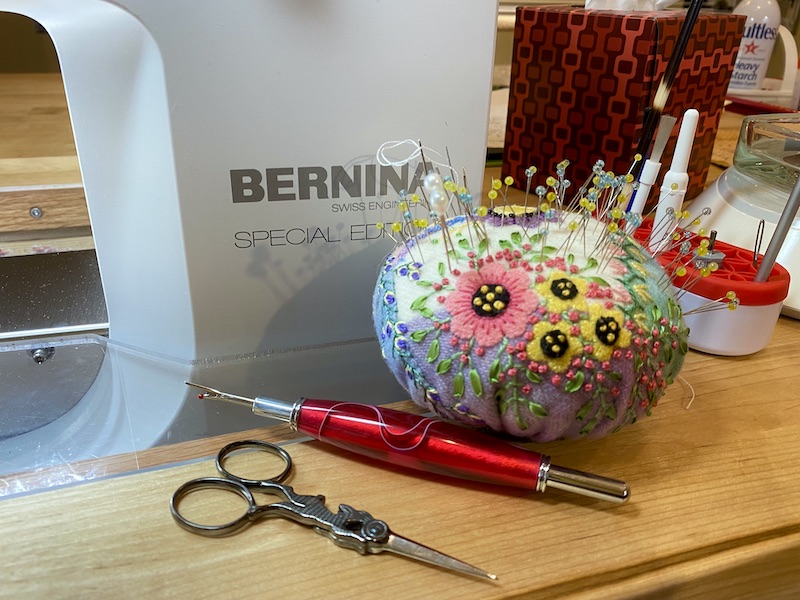
1. Hand Embroidered Felted Wool Pin Cushion from Etsy maker Martha of Quilt Shenanigans.  Who is this good for?  Anyone who does any kind of sewing at all can use a pin cushion, and these must take Martha hours to individually hand stitch and embellish with tiny beads.  Her hand stitching is exquisite, the felted wool is soft and luxurious to the touch, and the pin cushion is well-packed to hold its shape and is stable on a flat surface.  Even the slenderest pins slide in and out with ease, and she has lots of beautiful designs in stock to choose from.   

My New Favorite Pin Cushion, made by Martha of Quilt Shenanigans on Etsy 

2. Handmade, Hand Paired Embroidery Scissors from Maison Sajou.  These are manufactured by a 200-year old company in France, but available in several Etsy shops.  I got mine from Penelope Textiles' Etsy shop.  A few things to know: There are lots and lots of cheap imitations out there for a fraction of the price, but while the mass-produced knockoffs might look just as cute as photo props, there is no comparison to the way they actually cut.  It's like the difference between a Wustof steak knife versus the plastic knife that comes with your takeout order.  The lesser version SORT of cuts, but not cleanly or easily and it's not a joy to use!  Authentic Maison Sajou scissors are individually handmade by French craftsmen, with hand paired blades that are kept together throughout the entire production process to ensure that they match up perfectly. They are sharp, accurate, and cut smoothly and cleanly all the way to the tip (which is absolutely crucial for snipping the inside corner seam allowances in needle turned applique).  Who is this good for?  Anyone who enjoys any kind of hand stitching like cross stitch, embroidery, needle turned applique, or hand quilting would love to receive a pair of Sajou scissors!  In addition to the Hare design that I own, there is also a cute Eiffel tower version, gorgeous Art Nouveau Peacock scissors, and other historic reissue designs to choose from.  Of course, if you just want a cute pair of scissors for a photo prop, those cheaper knockoffs will suit you just fine!

Hand Paired Hare Embroidery Scissors from Maison Sajou, via Penelope Textiles on Etsy

Thursday, November 11, 2021

Two Very Special Clients' Quilts, and a Movie Star Moves Into My Studio

Happy Thursday, Friends!  I just finished writing a different blog post for TGIFF (Thank Goodness It's Finished Friday) that I've scheduled to publish automatically at 6 PM EST this evening, since that's when Friday begins for those linking up from Australia, so be sure to check back for that one and link up your own finishes, even if it's a small finish like a single block completed.  Meanwhile, I have a couple of extra-special client quilts that I've been wanting to share with you.  

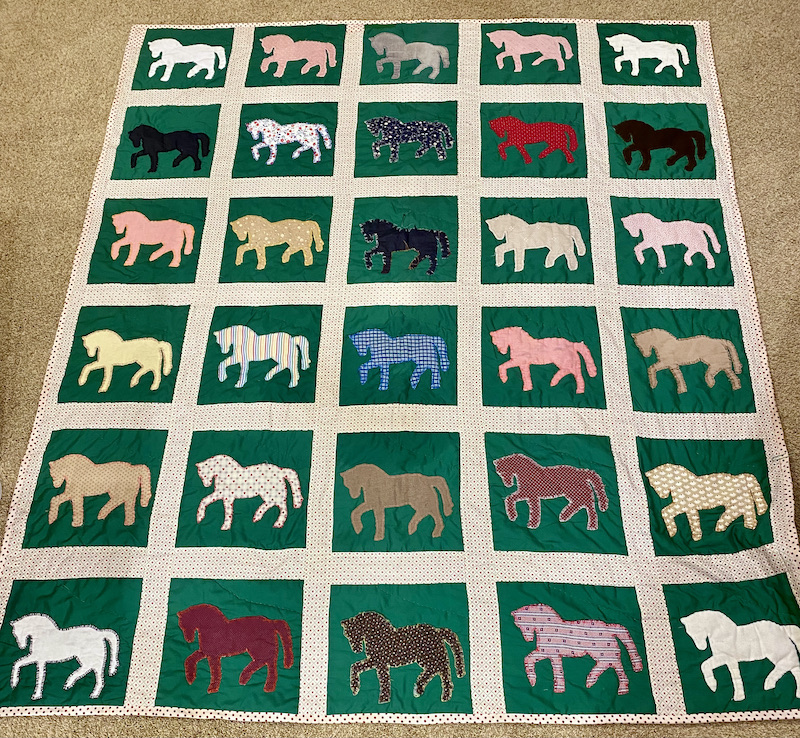
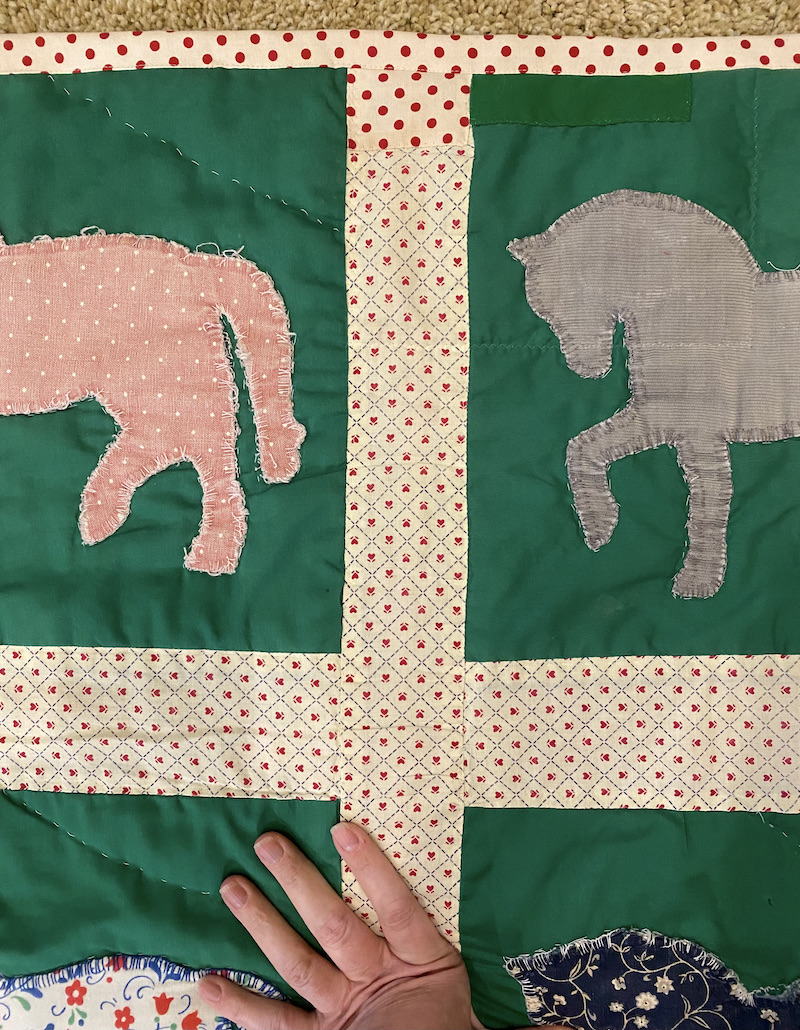
Julie's Vintage Equestrian Applique Quilt Repair

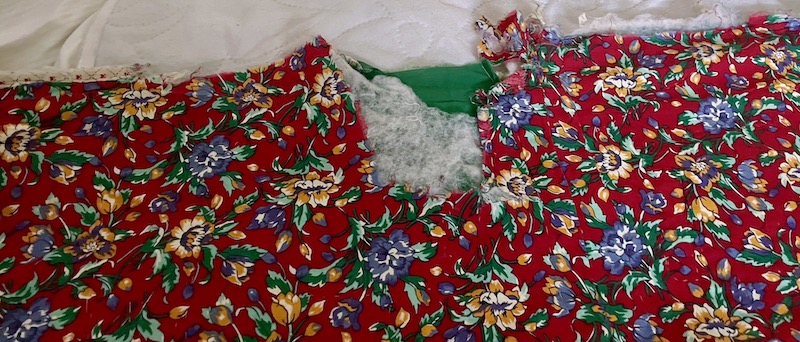
This first one belongs to Julie, whose puppy chewed a hole through all layers of the quilt at the top edge.  These dogs sure do keep me busy, don't they?!  I neglected to get a good "before" phot of the entire quilt before I started working on it, but here's what it looked like when it was nearly ready to go home again:

74 x 84 Vintage Equestrian Applique Quilt, After Repair

Julie cherishes this quilt because her husband had it custom made for her as a surprise gift many years ago.  Their family is involved with equestrian sporting and I believe he may have even drawn the horse silhouette for the applique shapes himself.  He found a quilter to make it and was given a shopping list of how much fabric was needed, then went to the fabric store and picked everything out himself -- hence the assortment of calicos, corduroys, and poly blend fabrics in this quilt.

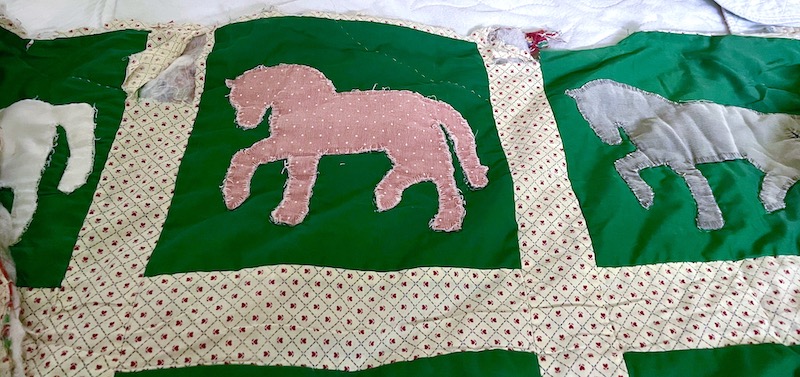
Detail of the Worst Damage Area

This quilt was made with a wide sashing between the blocks and a narrow, 1/2" finished width outer border in the same fabric that simply wrapped to the back of the quilt and was machine stitched in lieu of traditional binding.

Same Spot On the Quilt, Backing Side

Here's what that section of the quilt looked like after I'd repaired it:

Repairs Completed, All Machine Stitched

My client's budget dictated that all of the machine repairs would be machine stitched for this project.  The binding was damaged and falling off on all four sides of the quilt and would need to be replaced, and finding a suitable fabric was the biggest challenge.  I'd initially told Julie that I'd use a solid red for the binding, but I couldn't bring myself to do it.  My goal in restoring a family quilt like this is to have it look as much like it did originally as I possibly can, and although a red binding would look good on the quilt, it would definitely draw your eye and look different to its owners.  I could not find anything like the original ivory/red/blue print calico fabric in any of the local quilt shops I visited, but I did find a red and white polka dot fabric.  I was able to tone down the bright white background of the new fabric to better match the original fabric by coffee staining it before using it to repair the quilt.

Friday, September 3, 2021

Behind the Scenes: Digital Custom Long Arm Quilting With Q-Matic on a Judy Niemeyer Quilt

Good Morning, Happy Friday, Happy Labor Day Weekend, and Happy September!  It was in the fifties this morning in Charlotte, which felt GLORIOUS after the sweltering hot Armpit-of-the-South weather we've had for the past few months.  Fall is my favorite time of year and it can't get here soon enough!

Custom Digital Quilting Fit for a Prismatic Star Queen

Sneak Peek of the Custom Feather Quilting Under My Needle

I've spent more time quilting in the studio than sitting at the computer lately, so I have lots of things I could be sharing with you.  Today, I thought folks might like to see a custom quilting project that I'm working on for a client right now and learn a little bit about what goes on behind the scenes when custom quilting with digital designs.  Spoiler alert: the process is not as automated as you might expect!  Here's my client's quilt top, prior to being loaded onto my frame;

Auditioning Threads for Mildred's 91 x 91 Prismatic Star Queen Quilt Top

My client Mildred pieced this gorgeous Prismatic Star Queen quilt top using one of Judy Niemeyer's Quiltworx foundation paper piecing patterns.  

Thursday, August 5, 2021

Bring On the King-Size Quilts: My Q-Matic is Finally Here!

Today's big news is that my Q-Matics computer robotics that has been backordered since May finally came in and was installed on my machine yesterday!

Q-Matic Computer is Here, Up and Running on My 13' Long Arm

Now I can finally get to the Queen size quilts in my queue whose makers have been waiting so patiently.  I can now quilt anything up to 120" on my 13' Big Girl frame (Bernina calls it the Large frame, but I am calling it my Big Girl Frame after being restricted to the dinky little 8' frame at the Bernina store that couldn't handle anything bigger than a Twin).  Not only can I get caught up with larger customer quilts now, but I'm finally going to quilt my enormous 120" x 120" California King pineapple log cabin quilt -- if I can only make up my mind about how to quilt it!

It took my dealer about 5 hours to install my Q-Matic, and I managed to piece two more blocks for my Retro '80s Building Blocks sampler quilt while he was working in my studio.

Progress on my Sampler Quilt Project

Since my Featherweight was still set up from the LeMoyne star blocks I made last week, I chose two more blocks containing Y-seams (in the original Moda Modern Building Blocks quilt, these were made with flying geese units, but I redrafted them to have fewer seams).

Monday, August 2, 2021

Julie's Positivity Quilt for the Mercyful Quilts QAL

Good Monday morning and Happy August, y'all!  I'll get to my goals for the fresh week and shiny new month later in this post.  First, I want to show you this beautiful Positivity quilt, pieced by Julie Kennedy of Julie's Quilts & Costumes, and quilted by Yours Truly:

60 x 80 Positivity Quilt for Mercyful Quilts QAL

"Positivity" is a FREE pattern from Preeti Harris of Sew Preeti Quilts, available here.  Preeti and Bernie Kringel of Needle & Foot are currently sponsoring a QAL (quilt-along) using this pattern to create donation quilts for Bernie's Mercyful Quilts charity benefitting dying patients and their families at Mercy Hospital in Sacramento, California.  Those participating in the QAL, which runs through September 5th, are encouraged to either ship their completed quilts to Bernie or else donate them to local charity.  Although I didn't have time to piece a top for this effort, I was glad to collaborate with Julie in support of this worthy cause.

Positivity Quilt Pieced by Julie, Quilted by Me


One of the things I love about Preeti's Positivity pattern is that, although there's nothing explicitly religious about the plus sign design to non-Christians, Christian patients and their loved ones will see the plus sign as a cross -- a reminder of the promise of resurrection, which makes this quilt both physically and spiritually comforting.  I love the color palette Julie chose, too.  The blue crosses/plusses against the warm neutral background fabrics is calm, soothing, and organic, like earth and sky and water.  

Wednesday, July 21, 2021

The White On White Bailee Quilt, Final Reveal!

Today's post needs to be a quickie because I have a full day ahead of me, but I just had to share pictures of how that white-on-white "pieced whole cloth quilt" turned out.  My client picked it up yesterday and she'll be surprising her mother with it when she flies out to see her tomorrow.

The "Pieced Whole Cloth" Quilt, Bound and Ready for Gifting

My client is thrilled with how this project turned out and I can't wait to hear about her mom's reaction to the quilt.  This is supposed to be the white on white quilt that she always wanted but couldn't have because of her messy kids and dogs.  I think we nailed it, don't you?

56 x 68 Finished Quilt with Bailee Quilting Design

It's so hard to get pictures that do justice to the quilting when it's white thread on a white background.  

Friday, July 16, 2021

The Pieced Whole Cloth Quilt, Part I: Q-Matic Loves Karlee Porter Designs (and So Do I)!

OH MY GOSH, you guys -- I have died and floated off to quilting heaven!!!  Look what I started quilting yesterday for one of my clients:

Karlee Porter's Bailee E2E Design, Quilted on Bernina Q24 with Q-Matic

This quilt is a gift for my client's 80-something-year-old mother, who says she "always wanted a white-on-white quilt but she could never have one because she had kids and pets."  So my client pieced a very plain quilt top from large squares of assorted white and ivory solids and textures, and told me that "the quilting needs to be the star."  Now, in case you are wondering what is the best way to become my Best Friend Forever, it is DEFINITELY by telling me that my quilting gets to be the star of your quilt!  💕

Setting the Design Up in Q-Matic

When I purchased this particular design for my collection, I didn't think I'd ever actually stitch it out as an edge-to-edge design like this.  I was thinking I'd stitch single repeats of the design motif on plain alternate blocks for custom quilting.  The level of detail in this design is insane and it would be completely lost on a print fabric or busy piecing.  

Sunday, July 4, 2021

The High-Tech, Low-Tech, Good News and Bad News Update

Happy Sunday, Happy Independence Day to those of you in the United States, and Happy July, everyone!  Today's post will be a smorgasbord of high-tech and low-tech excitement that has accumulated over the past week.

The Charlotte Modern Quilt Guild hosted a Zoom lecture with Canadian quilter Libs Elliott a few days ago, which was fabulous!  Libs is best known for her use of computer code to generate random geometric designs for modern quilting.  She shared that her parents were antique dealers and that she'd discovered and fallen in love with old quilts at auctions and estate sales.  As she related her journey from trying to replicate traditional patchwork with hardly any instruction through creating ideas of her own on paper and then trying to figure out how to make a quilt that looked like her sketches, I really appreciated her spirit of adventure and the way her style and her process have evolved over time.

Enjoying Libs Elliott's Lecture on Quilt Design with Computer Code

I got some good news last week, and I got some bad news.  Good news first!  I found a buyer for my APQS machine, a quilter from Northern Minnesota who was delightful to talk to on the phone.  She will be driving over 1,300 miles come and pick up the machine this week, and I wish her a safe and smooth journey!

Bad news: I already sold the IntelliQuilter computer robotics that I had on my APQS Millennium, because my Q-Matic computer robotics for the Bernina was supposed to be here at the end of June.  Well, guess what?  The Q-Matic is now pushed back until at least August, due to the global shortage in microchips.  😧 Yikes!  That means I can't stitch any digital edge-to-edge quilts for another month!  My Bernina dealer, Creative Sewing & Vacuum, has graciously offered to let me use their demo Q24 machine at the store for computerized quilts that  I need to get done in the meantime.  The only catch there is that, to conserve floor space in the shop, their demo Q24 is set up on the smallest 8' frame and the widest quilt that will fit that frame is about 71".  Not big enough for the queen quilts in my queue!  I had a customer's baby quilt that needed to get done, though, so I brought it over to quilt it with Q-Matic at the store.  I can't show you this quilt quite yet -- the client is picking it up on Wednesday -- but I'm hosting TGIFF Thank Goodness It's Finished Friday this week and I'll show it to you then, okay?  Pinky promise!  For now you just get this little tantalizing glimpse:

Borrowing My Bernina Dealer's Demo Q24 with Q-Matic

Wednesday, June 23, 2021

Free-Motion Quilting with My New, Snazzy Quilt Beast: Meet the Bernina Q24!

Now that the vintage Corn & Beans quilt has been repaired and returned to its owner, I finally had a chance to start playing with my new Bernina Q24 long arm machine yesterday.  I am in Quilting Heaven!

First Free-Motion Stitches on my New Q24

This is a preprinted practice panel that I bought from Lisa Calle when I took her long arm quilting workshop in Paducah in 2019.  My Q24 was delivered with a full bobbin's worth of orange thread, so I threaded her up with a cone of So Fine thread, color Orange Julius in the needle for the maiden voyage.  I haven't done any free motion quilting at all for nearly a year, having been so focused on learning that IntelliQuilter computerized quilting system, so I'm a bit rusty -- but I just love how  this machine handles for free motion work.

Friday, May 28, 2021

Giverny Kaleidoscope Quilt Finish + Big Birthday Surprises: A Bernina Q24 is Coming Next Week (APQS Millennium + IntelliQuilter For Sale)!

Today's post is a long one; I have three things to share with you.  

1. Graduation Quilt Finished Early!

First things first, my lovelies -- I put the final stitches in the binding of Anders' high school graduation quilt last night.  I finished it EARLY, y'all -- graduation isn't until Tuesday, and Quillow Sunday at church is on June 6th.  Woo hoo!!  This was my One Monthly Goal for May, and it feels good to hit the finish line with several days to spare!

70 x 90 Giverny Teleidoscope Graduation Quilt for Anders

I really love how the ombre backing fabric came out, too:

Giverny Teleidoscope Ombre Backing

I ended up doing a 1/2" finished width binding on this quilt because it seemed more proportional to the oversized kaleidoscope blocks than my usual 1/4" binding.  As for the size, it came out right at 70" x 90" before washing it, and I used 100% cotton batting so I'm bracing myself for some shrinkage to happen in that first wash.  I had intended for the quilt to be a little larger, but it will be fine.

Wednesday, April 21, 2021

Giverny Teleidoscope Quilt Progress + Custom Sewing Cabinet Modifications

I'm still chugging along with my son's high school graduation quilt, in fits and snatches!  The real challenge is coming up with new pictures for each post about it, because it looks pretty much the same up on the design wall regardless of whether seams have been sewn together yet!  

Giverny Teleidoscope In Progress

You can't see the whole thing in the photo above, but the top six rows have corners attached and blocks sewn together into rows.  I have three more rows to go with attaching corners and joining blocks into rows.  There are no borders planned for this quilt, so once the top has been sewn together, it will be ready for quilting.

Tuesday, September 22, 2020

LAL#8: Fast & Frugal Method for Joining Batting Scraps by Machine


After loading the backing of my Modern Baby Clam Shells quilt on my frame a few days ago, I discovered that the package of crib sized batting I was planning to use was going to be too small for my 42" x 42" baby quilt.  Why do the batting manufacturers assume that everyone is making rectangular baby quilts, anyway?

With no nearby quilt shops open on a Sunday evening, I was determined to come up with a solution that didn't require shopping.  I briefly considered hacking a piece out of one of the batts I'm saving for larger projects, but then I started noticing all of the nooks, corners and cubbies throughout my studio where I had odd-shaped batting scraps squirreled away.


What you see pictured above is only what was left after I tossed the really skinny strips, the bits of batting that I couldn't identify, as well as remnants from battings that I tried but didn't enjoy using.  This left me with the remnants of Quilter's Dream Wool, Quilter's Dream Cotton Select in Natural and in White, Hobbs Heirloom 80/20 blend in natural, Hobbs Heirloom 80/20 in Black, and Hobbs Tuscany Wool.

I've been hoarding saving these batting scraps for about 20 years.  The smallest batting scraps are useful for cleaning the rails of my long arm machine, and I do use the bigger pieces sometimes for samples or for checking and fine-tuning tension, but I have not been using them up at a rate that keeps up with new batting scraps being trimmed away from finished quilts!  Desperate times (no batting for the baby quilt + batting scraps taking up WAY too much space in the studio) called for desperate measures.

How to Join Leftover Batting Scraps by Machine

First things first, I had to do my best to identify and sort the batting scraps.  If I cobbled together a Frankenstein batting that was part wool, part 100% cotton, part polyester, and part 80/20 blend, then the loft and feel of the quilt would be totally different from one section to another.  Even worse, those battings would shrink at different rates the first time the quilt was washed -- disaster!  So do as I say, not as I did, and try to get into the habit of bagging and LABELING your batting scraps as soon as possible after trimming them from a finished quilt, while you still remember what kind of batting they are!

Pictured below are two fairly large remnants of Quilter's Dream Cotton Select batting in Natural, perfect for my baby quilt once they're joined together.  I laid both pieces on my cutting table, side by side, both with the right side up (dimples up, pimples down for needle punched batting) and overlapped the two rough-cut edges slightly in the center.  Then, I used my longest acrylic ruler and my rotary cutter to cut a clean, straight line through both layers of batting to create edges that abut perfectly.


The bits I'd just trimmed from each batting remnant were perfect for testing stitch settings, to see which stitch would hold the batting edges together securely without puckering or creating a ridge along the join.


I tried a few different stitches, but I was happiest with the 3-step zigzag (stitch #16 on my Bernina 750QE), once I'd maxed out the width at 9 mm and stretched out the length to a bit beyond 3 mm.  I'm using 50/2 Aurifil thread in a creamy Ivory to match the batting.


This is one of those tasks where I really appreciate the extra throat space in a 7 Series Bernina. You can't join batting with right sides together because you don't want any seam allowance at all, just raw edges butted together with a light stitch holding them together.  Once the batting is quilted into a quilt, the quilt stitches will be what keeps the batting where it belongs inside the qult.


I started out using my Open Toe foot #20D for this with my Dual Feed engaged, and that did work, but I quickly realized that the walking foot would be better because the walking foot helps feed the fabric from either side of the needle, whereas Dual Feed rides along in dead center position behind my needle -- right on top of the gap between the two batting pieces that I'm trying to make disappear!


It was a lot easier to keep the two batting edges right up against one another with the walking foot, so that was worth the minute it took me to dig it out of the drawer and pop it on my machine!


Ta-da!  Can YOU see the vertical seam going down the middle of that batting?  I'm not necessarily going to do this on a show quilt, but this is going to be just perfect for my baby quilt!


There it is on the frame, ready for the quilt top to go on next.  I'll spritz the batting with some water first and let those wrinkles hang out overnight.

But Rebecca, Aren't There Other Ways to Join Batting Scraps?

OF COURSE there are other ways to do this!  I'm writing this post so I can remember how I did it the next time I need to do it again, not because this is the only right way to do it.  Some quilters like to whipstitch the edges together by hand.  Some quilters prefer to use a regular zigzag or some other utility stitch built into their sewing machines.  There is a fusible batting tape that some quilters love using -- BUT -- you must be 100% certain that you have correctly identified your batting fiber before you go anywhere near it with an iron!  Wool batting should not be ironed, and neither should any of the polyester fibers, as they would melt.  If you know it's 100% cotton because that's the only kind of batting you have ever used, then go ahead and try the fusible tape method.

Speaking of wool, I haven't tried my machine stitched joining method on a lofty wool batting.  I am definitely going to have to join batting for my monster-sized 120" x 120" pineapple log cabin quilt when I get around to quilting that one, because I need at least 128" x 128" of batting and backing and batting doesn't come that wide.  I think I'll whipstitch the extra length I need by hand to ensure my stitching doesn't flatten the loft along the join.

PSST!!  I'd Love to Quilt for YOU!

By the way, if you or any of your quilty friends has a quilt top or two that needs quilting, I'd be delighted to quilt for you!  My turnaround for edge-to-edge quilting is currently running about 2 weeks, and you can click here to find out how to book your quilt with me.

What do YOU do with Your Batting Scraps?

I'd love to know what you all do with YOUR batting scraps.  Do you save them at all or throw them out?  Do you use them in small projects or join them together?  Do you have a good system for keeping your batting scraps organized so you know what kind they are, what sizes they are, and so you can find the right piece when you need it?  Let me know in the comments!  Meanwhile, it's Tuesday again...  And that means it's time for the Long Arm Learning linky party!


You are invited to the Inlinkz link party!

Click here to enter

Saturday, August 29, 2020

Machine Piecing the Modern Baby Clam Shells Quilt, with Help from QNM

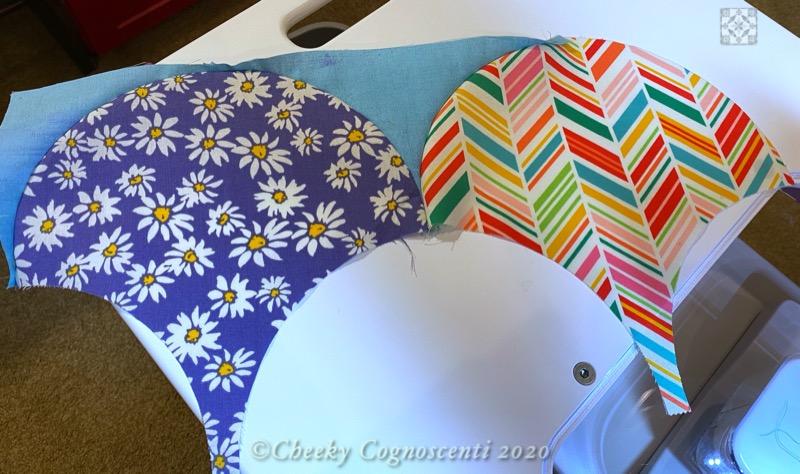
Hello, my lovelies!  My one and only weekly goal last week was to START -- just to start, not to finish, mind you! -- piecing my Modern Baby Clam Shells quilt.  I created the design in my EQ8 software in December of 2018, with a specific baby in mind whose due date was several weeks away...  Then it took me awhile to find the 9.5" acrylic clam shell templates I wanted to use (from an Australian Etsy seller who has since closed her shop).  Then I hemmed and hawed about the best way to cut out completely accurate 9.5" diameter circles (10" actually, since I needed a seam allowance).  After cutting out all the clam shells, circles, and partial clam shells, I then realized I didn't know how to sew them together!  I had my heart set on old school curved piecing, which I'd done for Lars's Drunkard's Path quilt eight years ago, but I wasn't sure how to go about piecing a clam shell quilt.  Do you start at the bottom and work your way up, or start at the top and work your way down?  Searching online, I either found instructions that confused me and explained only the part I already understood (how to sew a curved seam) and left out the part I didn't know (where to start and how to progress through the piecing of the quilt).  I also found patterns that subdivided the clam shells to simplify the piecing, or for using a prepared edge appliqué technique to avoid piecing altogether, neither of which interested me.  Ugh!  Annoying!  Set aside and ignored for a year and a half, until I made it my goal for THIS week:


So, as you can see, I've met that goal already because I did start the piecing!  Yay, me! 😉.  I'm using my Golidilocks machine for this -- my 5.5 mm Bernina 475QE, which is why I have my portable SewEzi table set up in my studio next to the big machine's cabinet.


So that's my quilt design rendering, created in EQ8 software.  It should finish at 40" x 40" unless I decide to enlarge it somehow.  There may or may not be embroidered butterflies before the top gets layered for piecing.


As you can see, I'm using a bazillion pins, because I want the smoothest, most accurate curve possible and I don't want to clip the seam allowances.  I prefer piecing with Patchwork Foot #37 on my little machine, and I bought a Bernina seam guide that I can snug right up against the side of my foot just like the seam guide that came with the #97D foot for my big 750QE machine.  Having that fence-like guide out in FRONT of the presser foot makes it so easy to to feed the curve smoothly with a deadly accurate 1/4" seam.  I'm also using my Patchwork Straight Stitch defaults (lower tension for my Aurifil 50/2 cotton thread and a shorter stitch length of 2.0).  On my 475QE it's stitch #1303, but the same exact stitch on my other Bernina is #1326 -- go figure!


Yay!  The first seam!!  As you can see, I started in the middle of my quilt.  Where should I add the next patch?  Let's put another clam shell onto the blue half circle!


Yay again!  Smooth round curves are making me happy!  This is awesome; why was I so afraid?!  Let's add a circle next!


But then I started second guessing how I was going about all of this and wondering if I was going to piece myself into some kind of a corner.  And I remembered an article I'd saved when I was going through a haul of ancient Quilters' Newsletter Magazines that a former member of the Charlotte Quilter's Guild gave me about a year ago.  (She wanted to donate them to a current member of the guild and I was the only person who raised my hand).  So I stopped piecing and (miraculously!) located the article, filed away in one of my ubiquitous 3-ring binders.


THIS!!  THIS is the information I'd been looking for, and I had to go all the way back to a March 1997 magazine to find it.  The instructions are for hand piecing, but all I really needed was that piecing diagram explaining that you start at the top, alternating between rows one and two, and then work your way down adding row by row beneath the first two.  That, the pressing direction for seam allowances, and the Fig. 6 photo showing that the seam allowances need to be kept open where two pointy clam shell sides meet up.  


Maybe I would have been fine if I'd kept working my way out from the middle of the quilt, but maybe there's a good reason for working top-down that would have caused frustration and swearing and, God forbid, seam ripping.  I'd rather not have to reinvent any wheels on this quilt that is already so far behind schedule, so I left off working on the middle rows and started working on the top and bottom rows instead, per the magazine instructions.


By the way, in the QNM illustrations they have cut out their clam shell using tag board templates to mark the seam lines and then adding 1/4" seam allowances beyond the drawn line.  That makes it easier for hand piecing, since you can check periodically as you're stitching to make sure your stitches are landing right on the seam line on the back of your work as well as on the front.  My acrylic clam shell template has small holes along the edges that I'm using with a Frixxion heat erase pen to mark alignment dots on my clam shells.  I know some people have had horrendous issues when they've used Frixxion pens to mark quilting designs on the front of quilts, with "ghost marks" left behind or the ink reappearing in certain situations, but I am just twirling the tip of the pen inside the hole to make tiny black dots on the WRONG side of my fabric.  They disappear pretty well when I iron them, and if they are not completely gone, well, they are on the wrong side of the fabric where no one can see them anyway!


So here you can see the completed bottom row of my quilt, all pieced and pressed!  I now know that a normal quilter would have used whole clam shells along the outside edge and trimmed after piecing, but it seems to be working just fine.  I think I planned for a 2" wide border in that same blue so the clam shells would float away from the binding. My top row is completely pieced now, too, in addition to that bit in the center that I'd already started before locating my instructions.  My plan now is to continue piecing down from the top and up from the bottom per the QNM instructions, joining the sections together at the center circles.

SO, having met my goal of STARTING the piecing this week, what are my quilting goals for the week to come?

This Week's Quilting Goals

  • FINISH piecing Modern Baby Clam Shell Quilt!  
  • Load next charity top on the long arm and decide how to quilt it
  • Write next post for my Long Arm Linky party and schedule publication for Tuesday morning!

I'm linking up today's post with the following linky parties:

SATURDAY

·       UFO Busting at Tish in Wonderland

SUNDAY

·       Frédérique at Quilting Patchwork Appliqué

·       Oh Scrap! at Quilting Is More Fun Than Housework

·       Slow Stitching Sunday at Kathy's Quilts

MONDAY

·       Design Wall Monday at Small Quilts and Doll Quilts  

·       Monday Making at Love Laugh Quilt

TUESDAY

·       To-Do Tuesday at Home Sewn By Us