Showing posts with label Machine Applique. Show all posts

Saturday, August 15, 2026

Stonefields Blocks 30-32: " Cara's Surprise"

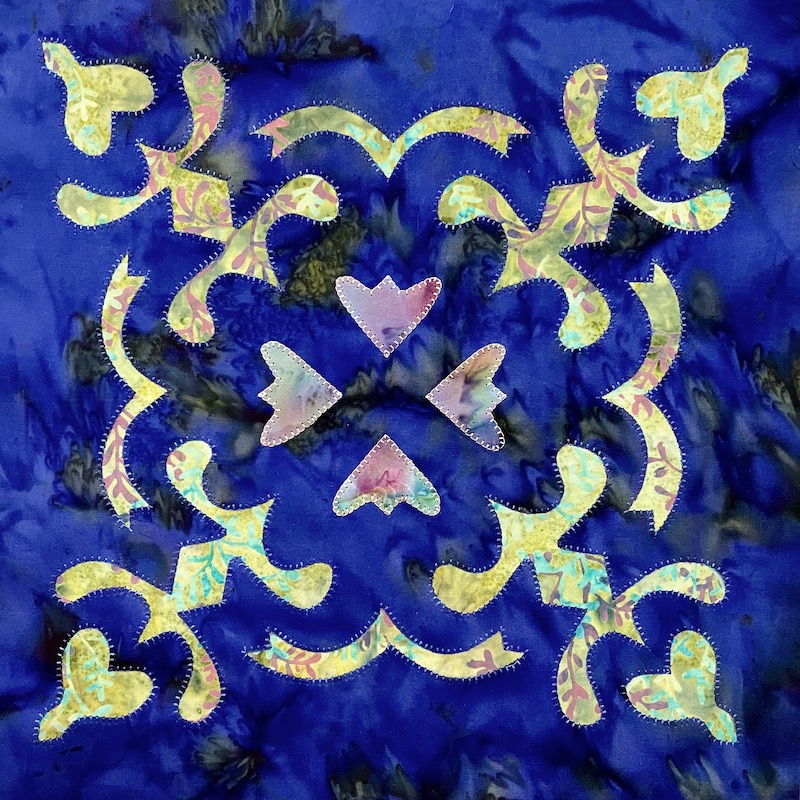
Well, this wasn't my goal for last week (nope, didn't piece that backing yet), but I finished the next three applique blocks for my Stonefields sampler quilt.  This is a pattern by Susan Smith and the blocks finish at 6" square.


Stonefields Blocks 30-32: Cara's Surprise


So, after machine piecing the "plus" unit for the centers of these blocks, I cut circles out of them with a turning allowance, ran a gathering stitch around the outside edge, and preturned the seam allowances with the appropriate size Karen Kay Buckley Bigger Perfect Circles heat resistant template and a bit of Maryanne's Best Press liquid starch.  I used a little roll of painter's tape to secure the template before pulling up the gathering thread and ironing the seam allowances, to prevent the template from sliding.  I wanted that plus sign to be as centered as I could get it in those circles.


Painter's Tape Kept "Plus" Centered During Starch and Press


It turned out like this, a little wonky but in a way that charmed me for some reason, so I left it be:


"Plus" Distorted a Little During Pressing


Friday, March 27, 2026

Stonefields Block 19 "The Oscillator," First of Two

Good Morning and Happy Friday, my lovelies!  It's been a busy week, but I managed to finish another appliqué block for my Stonefields quilt (pattern by Susan Smith).  Behold Block #19, "The Oscillator."


Stonefields Block 19 "The Oscillator"


I deliberately did not crop that photo because I wanted to show the difference between my hand stitched appliqué (the green and blue shapes at the bottom of the photo) and my machine stitched appliqué using the stitch I created with the Stitch Designer feature in my Bernina B990 sewing machine.  The size and spacing of the stitches is nearly identical and with Aurifil 100 wt monofilament thread in my needle and Microquilter 100 wt polyester thread in my bobbin, the machine stitches really do look just like my hand stitches in YLI 100 wt silk thread, even under inspection with bright lights and reading glasses.  I'm glad I took the time to customize that stitch on my machine so that I can switch between hand and machine stitching on the same project without any visible difference from one block to the next.

By the way, even using the sewing machine, this is "slow stitching" for sure.  It's like "hand stitching with a machine needle," as Harriet Hargrave said in a workshop I took with her years ago.  Very slow and deliberate stitching under bright lighting, one stitch at a time, constantly pivoting to keep those swing "bite" stitches perpendicular to the edge of the appliqué shape just as if I was hand stitching.  


Size 60 Microtex Needles Leave Visible Holes on Liberty Lawn, But They Will Close Up


The one thing that distracts me on this new block is that the needle holes are more visible on the machine stitched block than on my hand stitched blocks.  I use the smallest size 60 Microtex machine needle for this method, but my size 12 Bohin hand applique needle is skinnier than any needle that could go in a sewing machine.  The other difference is that the hand stitched block below used Tilda quilting cotton fabrics, and I used Liberty of London Tana Lawn prints for my Oscillator block.  The Liberty Lawn is a much lighter weight fabric with a finer, tighter weave and I think the different fabric characteristics are why the needle holes are so apparent right now.  I would expect my machine needle holes to be more pronounced with a batik fabric for the same reasons.  The good news is that needle holes close up when you wet the fabric yarns around them, so I'm not worried about it (I promise!).  It's just an observation.  Every time I step into my studio, my Gemini brain splits into two personalities, The Artist and The Scientist, both asking "What would happen if I tried it THIS way?"

Saturday, March 14, 2026

Stonefields Block 17 Remake + Mistake Discovered in Block 16

 You guys, I was so proud of myself when I switched off my sewing machine last night, put my new Stonefields Block 17 "Square Peg in a Round Hole" on my design wall, and went to bed thinking all mistakes had been corrected.  (If you're wondering what was wrong with the first one I made, read this blog post from a few days ago).  I strongly prefer the on-point orientation of that square with the circle cutout now that I've fixed it in my purple block.  The square on point element is repeated in many of the blocks in this quilt, and repeated design elements are one of the things that gives cohesion to a sampler quilt like this one.  


Stonefields Block 17, Just as Susan Smith and Rebecca Grace Intended


Before remaking the block, I took the time to trace over the ridiculously faint lines of the block pattern with an extra fine point Sharpie pen to make sure I could clearly see it through my fabric, because even with an LED light box you can't see these patterns well enough through most fabrics.  If I'd done that tracing and darkening of the pattern right off the bat, these mistakes would not have happened in the first place.  And I am hugely annoyed with pattern designer Susan Smith that I have to take all that extra time to trace over every stinking block pattern with Sharpie before I can use it, because the pattern cost $200(!!!) and there are hardly any instructions whatsoever, just vague hints and clues and anecdotes about the blocks, and how difficult would it have been to have these patterns printed with thicker, darker lines like every other quilt pattern author uses in their patterns?  GRRR...

So this morning I walked into the studio, admired all my pretty blocks on the wall (I finished a couple more EPP hexagon rosettes for the border yesterday as well:


Slow But Steady Stonefields Progress: My Design Wall Today at 8:19 AM


I am so glad I remade that purple block!  It only took me an hour or two and whereas the old block made me feel disappointed and annoyed with myself, the new block makes me feel DELIGHTED and pleased with myself for identifying what went wrong, adjusting my process to make errors less likely, and successfully creating the block exactly the way that I wanted it to look instead of settling for less.  

Monday, March 9, 2026

Stonefields Blocks 16 + 17 "Square Peg In a Round Hole," With an Oopsie!

There are two new Stonefields blocks on my design wall, and one of them even looks like it's supposed to!  Behold, Blocks 16 & 17, "Square Peg In a Round Hole," one of which has the square peg on point the way it belongs, and the other of which does not:


17 Stonefields Blocks + 21 Hexie Rosettes for Border


Aaaargh!!!  I only accept partial responsibility for this error.  The appliqué patterns for the Stonefields quilt are printed RIDICULOUSLY faintly, nearly impossible to see through the background fabric with even the brightest LED light box.  I did not realize that my background fabric was oriented incorrectly until after I'd glue basted the delicate purple square with the circle cutout onto my block, and I used a bit more glue than normal because of how skinny those bits are on the side.  I wanted to secure that shape to my background fabric while it was flat on my work surface to preclude any stretching or distortion that might occur.  In hindsight, I would have been better off skipping the darned light box altogether and just positioning the shapes on this blocks using the horizontal, vertical and diagonal fold lines.  Shoulda, woulda, coulda.  I noticed the mistake as soon as I finished glue basting the purple block and heat setting the glue with the iron.


Edges Turned Smoothly, Glue Basted to the Background, Not Yet Stitched


I considered peeling the shapes off to reposition them correctly before stitching, but when I tried to lift one purple corner I realized how securely it was glued down and didn't want to risk damaging the applique.  The prep work on these blocks took a LONG time and I didn't want to have any unnecessary do-overs!

Wednesday, September 17, 2025

Stonefields Blocks 14 & 15: Bordered 3/8" Hexagons

Hello, hello, HELLO, my Lovelies!  Look what I made yesterday and today, instead of packing or working on quilting my Deco quilt!  Behold, the Adorable and Delicious Little Bordered 3/8" Hexagon Blocks for my Stonefields sampler quilt project!  I had so much fun making these blocks!  (This post contains affiliate links).

6" Finished Stonefields Blocks 14 & 15: Bordered 3/8 in. Hexagons


The directions in the Stonefields Quilt pattern by Susan Smith are sparse, which is fine by me as I have difficulty following instructions anyway.  The pattern designer assumes everything, and I mean EVERYTHING, is stitched by hand.  That's fine if Methuselah is making this quilt, but those of us whose life expectancy is less than 900 years need to make peace with compromises from time to time.  I enjoy hand stitching but I am really, REALLY slow at it, so I'm mixing in machine work where it makes sense to me to do so.

For instance, why would I hand piece this square in a square block background when it is so easy to foundation paper piece this block and I can print my foundation paper patterns right from my EQ8 software to whatever size I need them to be?


Foundation Paper Pieced Background


I rough cut all my patches before FPP stitching and lay them out next to my machine.  Those fabrics in the lower left corner of the above photo are the ones I've selected for the hexie rosette that will be appliquéd to the center of this block later.


 6" Finished Block Background Ready for Hexie Rosette


And now, for the rascally little EPP hexies!  This was my first ever experience making EPP hexies.  Five years ago, I sewed an EPP monogram letter C block for a baby quilt (read about that here) and in August of 2016 I made unsuccessful experiments combining both FPP (foundation paper piecing) and EPP (English paper piecing) methods to piece a tricky block from the Farmer's Wife Sampler book (read about that here).  

Well, I've got more experience and better skills now than I had back then, and this time around I'm a lot happier with my results.  


Thread Basted 3/8 in. Hexies


Notes to Self (and to Other Interested Parties):

  • I'm using commercially made hexagon templates with 3/8" sides.  They came in an optional kit that I purchased with my pattern.
  • After reading a blog post from the Brimfield Awakening EPP gurus where they experimented with different stitching methods and threads, I decided to thread baste my hexies using 50/3 cotton Guttermann thread and a size 10 milliners needle, but switched to 100 wt polyester Microquilter thread with a size 11 milliners needle to whipstitch the edges of my hexies together.  Microquilter from my long arm quilting thread stash was the closest thing I had to the 100 wt poly Invisafil thread that Brimfield Awakenings recommended.

Whipstitching With 100 wt Microquilter + Size 11 Milliners Needle


Even in the ultra-fine, thinnest weight available, so skinny that you can't see the stitches as you're making them, 100 wt polyester still has the strength of 50 wt or even 40 wt cotton thread.  I wish I'd known this for my previous EPP attempts!  The thread really does make a huge difference.


Whipstitched Seam in 100 wt Microquilter Thread


See?


Zoomed WAY In to See the Stitches


And here that seam is from the right side, again, this is a zoomed-in photo which is why the fabric weave looks like a waffle.


Same Seam, Right Side


I needed just one Wonder Clip to hold things securely positioned while I was hand stitching.  I made my first hexie rosette by attaching all six outer ones to the center first, then stitching the outer hexies together one short seam at a time.  On this second rosette I tried attaching each outer hexie completely, in an "L" seam, and preferred doing it that way.


Wonder Clip Love


Here's my completed hexie rosette.  I really have absolutely no idea how long it took me to make this little cutie because I was zoned out in my Happy Place, giggling and smiling like a fool and paying no attention to the sun's travels across the sky...


HEE HEE HEE HEE HEE!!!  😍


And then all of a sudden it was four o'clock in the afternoon and I was wondering where on Earth did my day go, and what about all of those other things on my To Do list!!  Having reprogrammed and saved my own personal preferred invisible appliqué stitch on my Bernina B990 sewing machine (read about that here), I decided that I'd spent enough hand stitching hours on each of these tiny hexie rosettes and gave myself permission to appliqué them to their respective block backgrounds by machine.


Invisible Machine Applique on My Bernina B990


More Notes to Self:

  • I gave each hexie rosette a good starching and pressing before and after removing the template papers.  Then I used tiny dots of Roxanne's Glue Baste It to secure them in position on my block backgrounds.  The starch and the extremely narrow width of my appliqué stitch precluded the need for any stabilizer during machine stitching
  • I used invisible monofilament thread in a size 60/8 Microtex needle, with Microquilter in my bobbin
  • I used my open toe presser foot #20D and turned on the B990's laser feature, which shines a dot of red light precisely in the location of the next needle penetration.  That made it really easy to ensure that every stitch landed exactly where I needed it as I navigated around the perimeter of the rosettes
  • I did not use my machine's auto securing or auto trim features.  Instead I held onto my thread tails at the beginning, ended stitching at the exact point where I'd begun, threaded the tails into a hand needle and pulled them to the back of the work to tie off

Tra-la-la-la-laaaaaaa!  


So, what do y'all think?  Is this sacrilege?  Hand sewn EPP hexagon rosettes machine appliqué to the block!  I should note that it IS possible to sew EPP with the sewing machine; I hunted down and watched several different methods of doing so on YouTube.  I decided that either the results shown in the tutorials didn't meet my personal standards, or that the machine  methods looked too fiddly to bother with.  Not that I wouldn't try them ever, on some other project, perhaps one where I was working with larger patches.  

Machine appliqueing the rosettes to my backgrounds made sense because I am really, REALLY pleased with how closely my new machine applique stitch resembles my hand stitching, doing this step by machine prevented any fraying of my already-to-exact-size background block due to scrunching and handling the block during hand applique stitching, and I felt I had invested my hand stitching time into the aspect of the block where I got the biggest payoff for those efforts.


How Do I Love My Sewing Machine?  Let Me Count the Ways...


Side note about how that laser feature works on the B990, because the marketing materials do a terrible job of explaining why anyone would want this for reasons other than machine embroidery.  I stopped my machine with the needle in the down position for the photo above, which is why you don't see any red dot of light on the work.  When the laser light is turned on, each time the machine's needle goes to the UP position, it shines that red dot of light onto the next place where the needle is going to go DOWN, and that helps ensure that the needle is landing in the background fabric for the straight stitches and biting just barely into a thread or two of the appliqué fabric at each swing "bite" zigzag stitch.  You can also tell as you're approaching an inside or outside corner exactly when to pivot your work.  No more guessing and getting that "almost right!"  


Backing Trimmed Away


Not sure whether it was all the starch I used to ensure my hexie rosettes held their shape after template removal, but it felt like there was a lot of bulk at the center of these finished blocks so I trimmed the background fabric away behind each rosette.  Remember that these are 3/8" hexies with 1/4" seam allowances so each one is already two to three layers thick.  Not sure whether this is a "done thing" with English Paper Piecing but it's "done NOW!"

Here are all of my completed Stonefields blocks on my design wall together:


Stonefields Completed Blocks 1-15


Two things: the blocks I finished today may look "out of place" with the others from a value perspective, but I'm not worried.  They will be fine once they are joined by other blocks that have more "stage presence."  Second, most of those appliqué blocks still have oversized backgrounds.  Part of me thinks I ought to wait to trim them down until I'm ready to assemble the blocks into a finished quilt.  Sometimes I think maybe I should wash the blocks to remove the starch and basting glue, and then trim them down.  And then another part of me thinks I ought to trim them down RIGHT NOW because it's harder to get a sense of how the whole quilt is taking shape when some of my blocks are 6 1/2" and other blocks have excess fabric around the edges.  Anyone have any advice?  When I take all of the blocks off my design wall for my upcoming move, I'll be storing them neatly in a project box and I don't think they are going to ravel and fray no matter what I do.  Also, it would be stressful and unpleasant to have to trim down ALL the appliqué blocks near the end of the project.

Alright, enough about this for today. Gosh, I don't even know what day it is.  Wednesday?  Thursday?  I need to get back to the stitch in the ditch quilting on my Deco quilt again tomorrow for sure!

I'm linking up today's post with the following linky parties:

Monday, September 1, 2025

September Goals: Stonefields, FrankenWhiggish, Inherited UFO + BIG News for Rebecca
Happy Labor Day in the United States and Happy September, everyone!  I have a lot going on right now and my Big News (which I shall reveal towards the END of today's post) is going to dictate which projects and tasks take priority this month.

Stonefields Quilt

First, let's talk about my Stonefields quilt, because I am delighted with this project so far.  These blocks have been such a treat to work on!  All 13 of the blocks from Month One are now completed and on the design wall.  All blocks will finish at 6", but the applique backgrounds were cut oversized and will need to be trimmed down.  Because I use starch and glue in my applique preparation methods, I am thinking I might wash my applique blocks before trimming them down to size.  The serged edges will prevent them from fraying whether I hand wash them in a little dish pan or -- gasp! -- put them in a lingerie bag and run them through the washing machine on the Hand Wash Delicates cycle.  Honestly, that is probably exactly what I will do, because I know the washing machine will get all the glue and starch out very efficiently and I am more curious about what will happen in the washing machine than I am worried about what will happen in the washing machine.  


Stonefields Blocks 1-13 Completed, Appliqué Blocks Need Trimming to Size


My Sawtooth Star blocks were foundation paper pieced on the sewing machine, most of my applique blocks were stitched by hand, but the final Posy Pot block is a mixture of some shapes stitched by hand and other shapes stitched with my Bernina B990 sewing machine:

Stonefields Block 13 "Posy Pot"


I am absolutely delighted with my customized invisible machine appliqué stitch and how closely I got it to resemble the look of my own personal hand stitching.  

Sunday, August 24, 2025

Keeping Up With the Gretchens: Hand Stitching vs Bernina B990 Invisible Machine Appliqué Experiment for Stonefields Blocks

Good morning and Happy Sunday, everyone!  After my reckless but ultimately successful experiment on my Deco quilt last week (read about it in this post, which I edited and updated after coming back to the quilt and realizing that all was well after all), I decided to conduct another Mad Scientist Experiment on my Stonefields quilt project.  You may have heard of Keeping Up With the Joneses or Keeping Up With the Kardashians, but I'm all about trying to keep up with my blogging friend Gretchen who is cruising through her Stonefields quilt and leaving me behind in the dust!  Just kidding; I am delighted that Gretchen, Chris, and Hanne were all successfully cajoled into starting or resuming their Stonefields quilts (pattern by Susan Smith available here) as a very informal quilt along with me.  I know it's not a race, but I must be the slowest stitcher ever to have threaded a needle and it can be discouraging to put in so many hours and see so little progress -- especially since there are so many challenging and intense quilts that I want to make (I am thinking of YOU, Star Upon Stars, Down the Rabbit Hole, Simple Folk, and Happy Days!).  Behold my design wall with Blocks 1-12 completed.  Block 13 is another appliqué block that is prepped and ready for hand stitching in the coming days.  (This post contains affiliate links).


Completed Month One Blocks for Stonefields Quilt, One More to Go

Earlier in the week, out of mild curiosity, I timed how long it took me to stitch the 3 1/2" diameter cheddar print circle in one of my Pomegranate blocks.  Wanna take a guess?  


Hand Stitching a Pomegranate Block for Stonefields


It took one hour and seven minutes for me to stitch down that circle.  That was uninterrupted continuous stitching, not including threading the needle, trimming away the backing fabric, and not including stitching the light blue orange peel shape that I've started on in the photo.  No wonder I'm not able to keep up!  I am the snail of stitching!  

Monday, October 2, 2023

Margaret Willingham's Reverse Appliqué Workshop, Charlotte Quilters' Guild + My Deco Quilt Progress

Happy Fall, Quilters!  Guess what -- I took an actual, in-person workshop with the Charlotte Quilters' Guild last month AND I finished my workshop block after I got home!  I'm so proud of myself for 1. Taking a day off, 2. Trying something new, 3. FOLLOWING DIRECTIONS during the workshop 😬, and then 4. Adapting what I learned in class to suit my personal preferences once I got home to my own studio.  

My 12 x 12 Block from Margaret Willingham's Reverse Appliqué Workshop


I'll tell you more about the workshop in a minute.  First, I have other news to share -- I've made some progress and gotten over the Cutting and Kitting Hurdle with my Deco Quilt that has been in-progress/abandoned for the past two years!  Well, better late than never.  I am supremely pleased with my clear plastic tote bag containing all of the pieces for all of the blocks, neatly organized and labeled in little Ziplock bags.  Our guild has lots of social sewing opportunities throughout the month and, as President of the guild, I try to attend as many of them as possible.  Having a project packed up and ready to go (versus strewn around my studio!) is my biggest challenge, but now I'll just be able to grab a Ziplock bag of block pieces and wheel my travel machine out the back door.  I have a feeling this project is about to pick up STEAM!

My Deco Quilt Completely Cut Out and Kitted, Block One Variations In Progress

Now that I've finished ALL of the cutting for my Deco Quilt, I am officially caught up with Week Two of the Deco QAL (Quilt-Along) that I committed to in the Fall of 2021!  😂. Week Two was cutting out all of the fabric pieces for the entire quilt.  I am like that last straggling marathon runner who crosses the place where the finish line used to be, two years after the race has ended...  Not only am I caught up with Week Two, but I'm also about a third of the way through with Week Three of the Deco QAL, which is the week where you piece all of the Block One log cabin variations.  All 16 blue/green log cabin blocks are finished and all 12 of the half blocks in both colorways are finished and I have 32 blue/purple log cabin blocks remaining to be sewn. The cutting for this quilt was monotonous, but the actual sewing is pretty easy.  I think that completely finishing this quilt top was supposed to be my OMG (One Monthly Goal) for November of 2021; maybe I can get it finished by November of 2023 instead!

Monday, July 24, 2023

Halo, Modern Double Wedding Ring, and Baby Moose Quilts

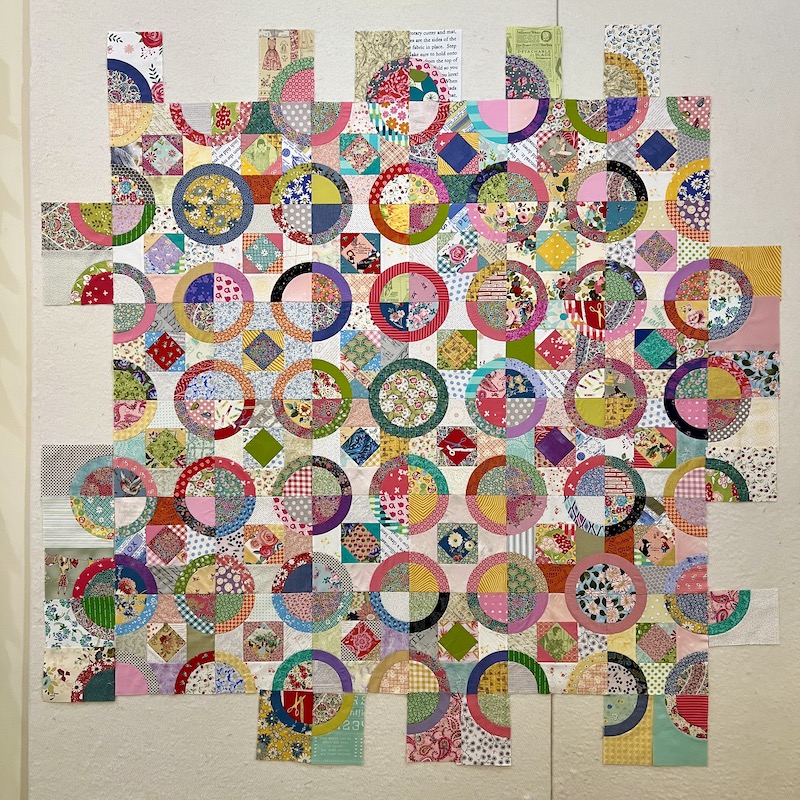
Hey there, Quilter Peeps!  Behold, my Halo quilt top is finally nearing completion:

Center Blocks Sewn Together, Border Blocks In Progress

I hesitate to set personal sewing goals with actual deadlines, but doesn't it look like I could get this quilt top finished by the end of this week?  Now that I've said that out loud, my house will probably be carried off to Oz by a tornado.  Or my sewing machine will blow up.  I'm not even sure which of those scenarios would be more catastrophic -- that would depend on how backed up my Bernina dealer is for repairs, and whether or not there are any good quilt shops in Oz.

For those who haven’t seen this one before, Halo is a pattern by Jen Kingwell that is sold in the pattern booklet Jenny From One Block, available on Amazon here.  (This post contains affiliate links).  If you’re local here in Charlotte, North Carolina, the QuiltPatch shop in Matthews has been offering classes for this quilt (taught by the fabulous Teresa Raleigh), but if you’re already comfortable with curved piecing you will do just fine on your own with the pattern as I did.  The Halo acrylic template set is optional but really helpful for accurate cutting of these shapes, along with a 28 mm rotary cutter (the standard 45 mm rotary cutting blades don’t work well along curved edges).

It never ceases to amaze me how much smaller a quilt gets when the blocks are actually sewn together compared to how big it looks when the individual blocks are stuck on the design wall side by side.  All of those quarter inch seam allowances really add up.  Or rather, they really “subtract up” from the size of the quilt top.  So much work for such a relatively small lap quilt!  I think this is supposed to finish at 66” square.  Well, thank goodness I wasn’t trying to enlarge it to King size this time!

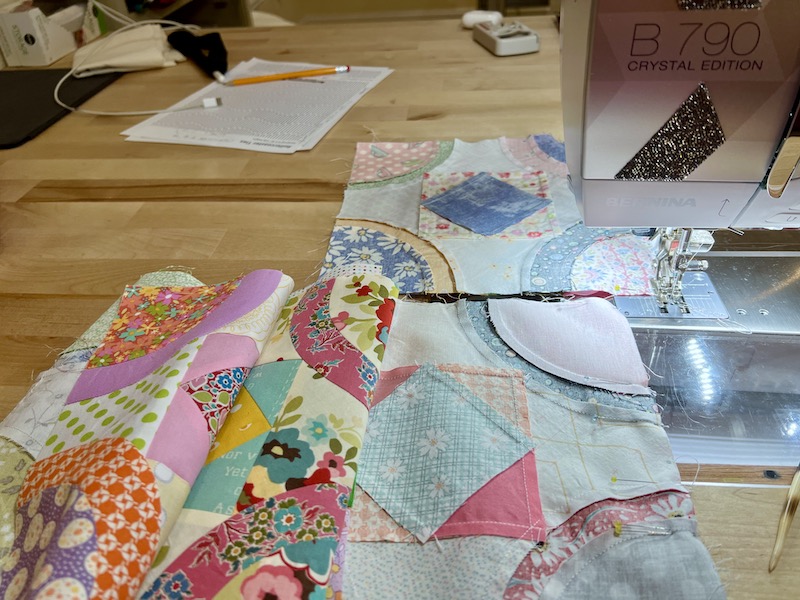
I always enjoy making blocks more than sewing them together, for whatever reason.  Maybe I’m just impatient by the time I’ve finished making enough blocks.  Still, these went together without too much trouble, just careful pinning where the seams need to match up.

Making Blocks is More Fun Than Sewing Them Together

So now all 36 Halo blocks have been sewn together into the main body of the quilt top and I'm just working on those rectangular pieced border blocks.  Which, by the way, is an interesting design choice from pattern designer Jen Kingwell -- the border blocks complete the half circles that would otherwise land on the outer edges of the quilt, deemphasizing and obscuring the block construction in favor of rings and squares that seem to float on a scrappy pieced background.  The borders also enlarge the quilt to a more useful size and create outer edges that can be easily bound without fretting about losing any triangle points or turning rings into flat tires.

That’s about all I have to say about Halo for now.  So let’s have a glimpse of the most recent client’s quilt fresh off my long arm frame:

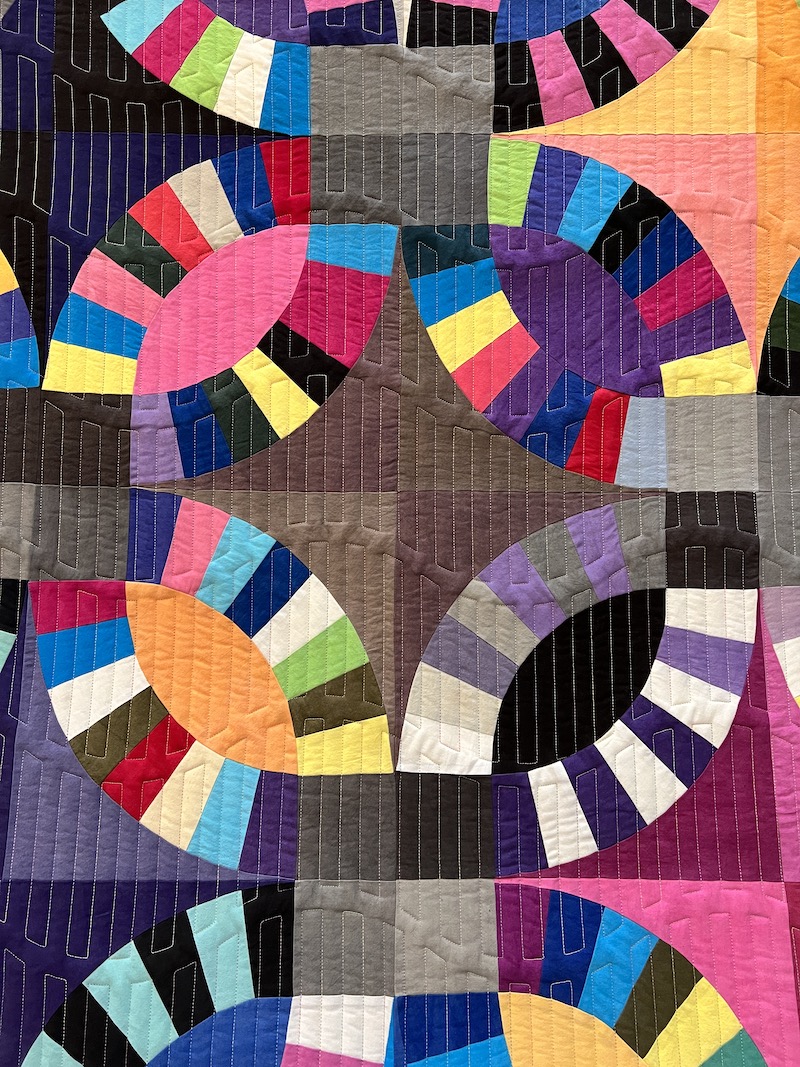
Tara Faughnan’s Double Wedding Ring for Cheryl

Now, you only get a sneak peek at this one, because this quilt is still on a UPS truck headed back to my client Cheryl in Minnesota.  This is Tara Faughnan’s Double Wedding Ring pattern, and Cheryl’s version is a massive king size made up in Cherrywood hand dyed solid fabrics.

Glimpse of Cheryl's Double Wedding Ring Quilt

I just love the color palette Cheryl created for this one!  This quilt is truly magnificent in person.  I used Hobbs Tuscany Cotton/Wool batting for Cheryl’s DWR and quilted it with YLI 40 Tex cotton thread in variegated Pastels.  Pattern designer Tara Faughnan was new to me before Cheryl sent me this quilt, but I checked out her Instagram and her online shop and I really like her work.  

Sunday, July 9, 2023

It's Easier to Get Forgiveness Than Permission: Quilting The Godfather for Marguerite

The quilt I’m sharing today was made by my friend and fellow Charlotte Quilters’ Guild member Marguerite.  It’s a project she started during the Pandemic, experimenting with using Terial Magic in lieu of traditional tearaway or cutaway stabilizers, various decorative threads, programmed stitches on her Bernina sewing machine, etc.  When I saw this unquilted top hanging forlorn and forgotten in her studio, I asked if I could quilt it for her as payback for a HUGE favor she did for me in a time of need (that’s why I call this one The Godfather, because “Some day, I will ask of you a favor…”  😅)  Not only did Marguerite agree to let me quilt it, but she uttered the most dangerous words imaginable...

“Just Do Whatever You Want With It!”

Marguerite’s 60 x 60 Appliqué Quilt with Bee and Lady Bird E2E Quilting

I very rarely agree to select a quilting design without any input at all from the client.  My usual practice is to consult with clients about quilting designs, batting and thread options when they drop off their quilt top (or once they’ve shipped it to me), and then I make recommendations based not just on what I see but also on what drew the client to select that pattern and those fabrics, who the quilt is for, and how it will be used.  I can usually envision two dozen totally different quilting designs that would look great on every quilt top I see.  Listening to a client talk about her quilt is just as important as looking at her quilt if I want the client to be over-the-moon delighted once the quilt is finished.  But Marguerite insisted, "Just do whatever you want."

I Quilted Bugs All Over Marguerite’s Quilt, And She’s Still Friends With Me

I briefly considered custom quilting on this one: You know, this design for the sashing, that design for the corner squares, quilting some additional “ghost flowers” along the border vines and subdividing the center of the quilt with different fills in different sections.   But Marguerite does a fantastic job of her own custom quilting using rulers and free motion motifs on her hand guided sit-down long arm machine, and if she wanted it quilted that way she could have done that beautifully herself.  Moreover, in addition to saying "just do whatever you want," she'd also said "just do an edge-to-edge," so I settled on this Bee and Lady Bird design from Scottish designer Dastardly Line.  

Thursday, July 6, 2023

Aurifil 40/2 vs Forty3 Cotton Quilting Thread: Mary's My Happy Place, Ramona's Escher Connected + A Sneak Peek of Mary's Mid Century Mod Quilt

Good morning and welcome to the sultry, sweaty, swampy month of July!  Today I'm sharing two beautiful but very different quilts (and giving you a glimpse of a third gorgeous quilt) that were all quilted with "forty-weight" Aurifil cotton threads.  I'll be showing you the enormous difference between forty weight TWO-ply versus forty weight THREE-ply thread.  

When comparing two spools of thread that are labeled with the same weight but different ply, the 3-ply thread is a full 50% thicker than a 2-ply thread of the same exact weight.

There's a common misconception that if two cotton threads are both labeled "forty weight," they should be approximately the same thickness and should look and behave the same when stitched out.  In reality, that weight designation only refers to the weight and thickness of a single "ply" or strand of that thread, and the cotton threads we use for piecing and for quilting are typically either 2-ply (two strands twisted together) or 3-ply (three strands twisted together).  This explains why Aurifil's popular 50/2 cotton thread (the one on the orange spool) creates less bulky seams and performs better with smaller needles and sometimes different tension settings compared to 50 weight 3-ply threads such as Mettler, Gutermann, etc.  When comparing two spools of thread that are labeled with the same weight but different ply, the 3-ply thread is a full 50% thicker than a 2-ply thread of the same exact weight.  (This post contains affiliate links).

Aurifil 40/2 (Green Spool) Natural White Blends and Disappears Across Applique

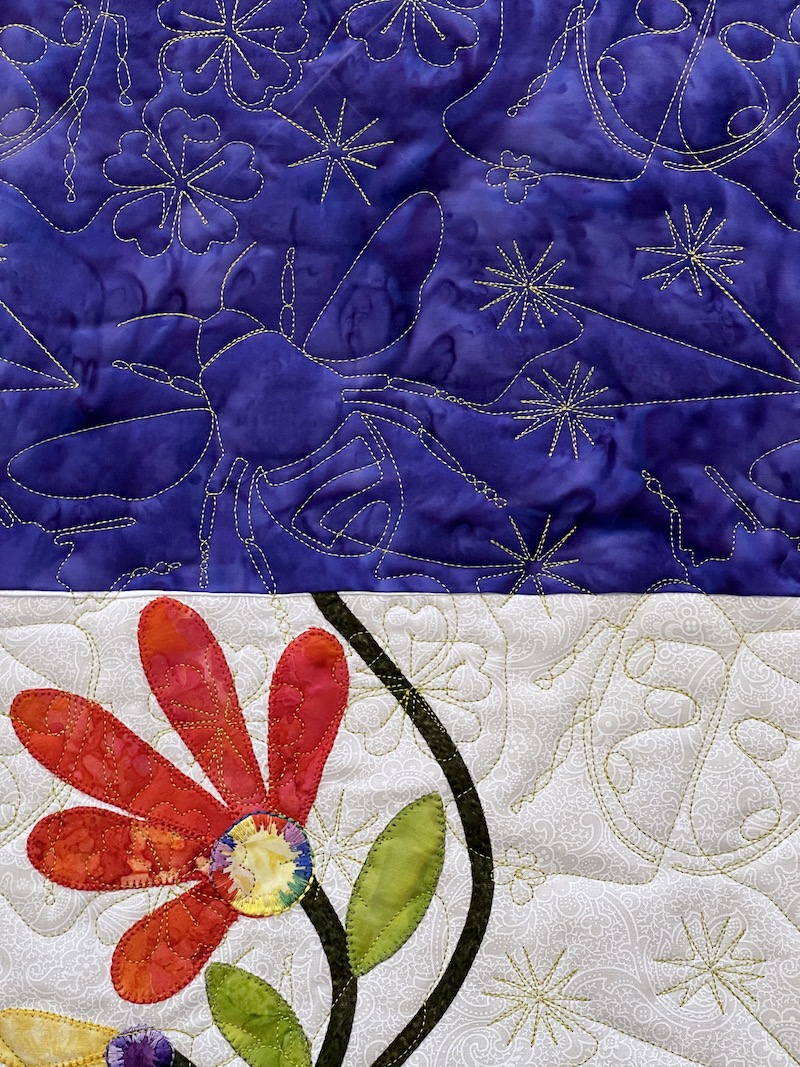
In the photo above, I've quilted the Chantilly Lace E2E design across a client's appliqué sampler quilt using Aurifil's 40/2 cotton thread in Natural White.  This is their popular 2-ply forty weight thread that comes on a green spool and is widely available in quilt shops.  Although Aurifil 40/2 is a thicker, more pronounced thread than the Aurifil 50/2 that comes on orange spools (confusingly, bigger weight numbers indicate skinnier and finer individual strands or plies), 40/2 cotton is still what I consider a lightweight blender thread for long arm quilting.  Notice how the quilting stitches take on a greenish tint where this thread crosses green fabrics, but the thread seems to be a pale pink where it's stitched across the pink petal fabric.

Aurifil Forty3 Black Stands Out Dramatically, Even Against Busy Print Fabrics

In the photo above, I've quilted the Wishbone E2E design using Aurifil's Forty3 cotton thread in Black.  Aurifil has created this thread specifically for long arm quilters, it’s only available on giant yellow cones (not spools), and it’s not as widely available at quilt shops as their 50/2 (orange spool) and 40/2 (green spool) cotton threads.

I selected Aurifil Forty3 cotton thread for Ramona’s Escher Connected quilt because busy prints like these are notorious for rendering quilting designs all but invisible and we wanted a thread that would disappear against the black background fabric but show up more dramatically against the prints.  

Saturday, October 29, 2022

Edge-to-Edge Quilting Over Machine Appliqué: Megan's Fiesta de Talavera + Debbie's Modern Rectangular Chevron Quilt

Good morning and happy Tuesday Wednesday Thursday Friday Saturday!  I've been working on this post in fits and snatches throughout the week.  😉  

So, the Barnful of Quilts show in Waxhaw that I told you about in my last post went off without a hitch a couple weeks ago.  It was a perfect early autumn Saturday, the air crisp without being cold, all the trees in peak foliage and beautiful sunshine filtering into the barn to illuminate the quilts on display.  Many thanks to host and organizer of the show, Valerie Fox of Fox Family Farms, and to her co-organizer (and my client) Megan Shein and their small army of volunteers who scrubbed the barn spotless, climbed ladders to hang quilts, and saw to the myriad details that made the event a smashing success!

Megan’s Glorious Fiesta de Talavera Quilt

One quilt that I especially enjoyed seeing at the show was this machine appliquéd quilt, Fiesta de Talavera made by my client Megan.  This was one of several quilts I’ve quilted for Megan that were exhibited in the show, but it's the only one I hadn't shared yet on my blog.  Doesn’t it look fantastic hanging from the barn rafters?  

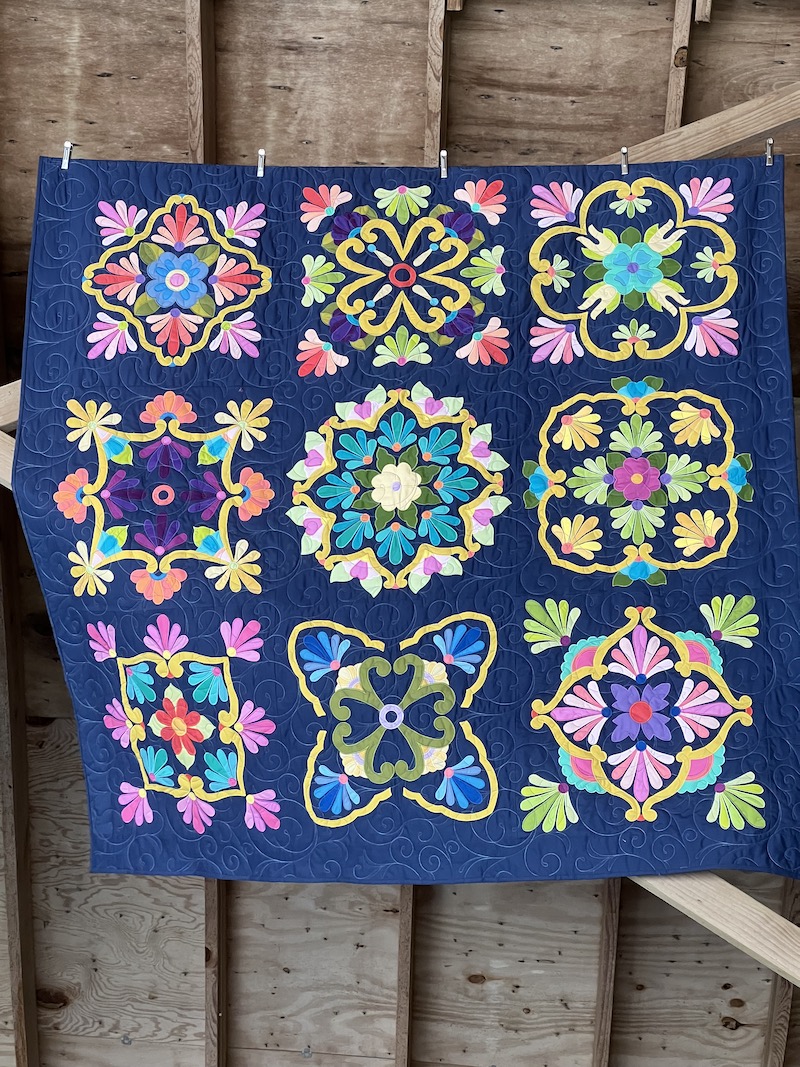
Megan's 67 x 67 Fiesta de Talavera Quilt with Denali E2E Quilting

Fiesta de Talavera is all fusible raw edge appliqué, satin stitched, done completely "in the hoop" using machine embroidery, and Megan made this quilt in a class at a local shop that specializes in machine embroidery.  The Fiesta de Talavera pattern and digital machine embroidery designs are by J. Michelle Watts for Anna's Awesome Appliqué Designs, available here on Etsy (this post contains affiliate links).  I should mention, for those who haven't done any machine embroidery -- just because it's computerized doesn't mean it is instant!  This quilt required hours and hours of cutting and stitching over weeks and weeks to create all of these intricate blocks, and once all of the embroidery was finished the blocks still needed to be sewn together the same as any other quilt top.  I'll circle back to this quilt and give you more details about it later in this post, but first I want to show you another client's completely different style of machine appliquéd quilt that I also quilted with an allover, edge-to-edge design.  We tend to associate appliqué with traditional quilt styles, but it's a useful technique for modern quilts, too.

Debbie's Stunning Rectangle Chevron Quilt


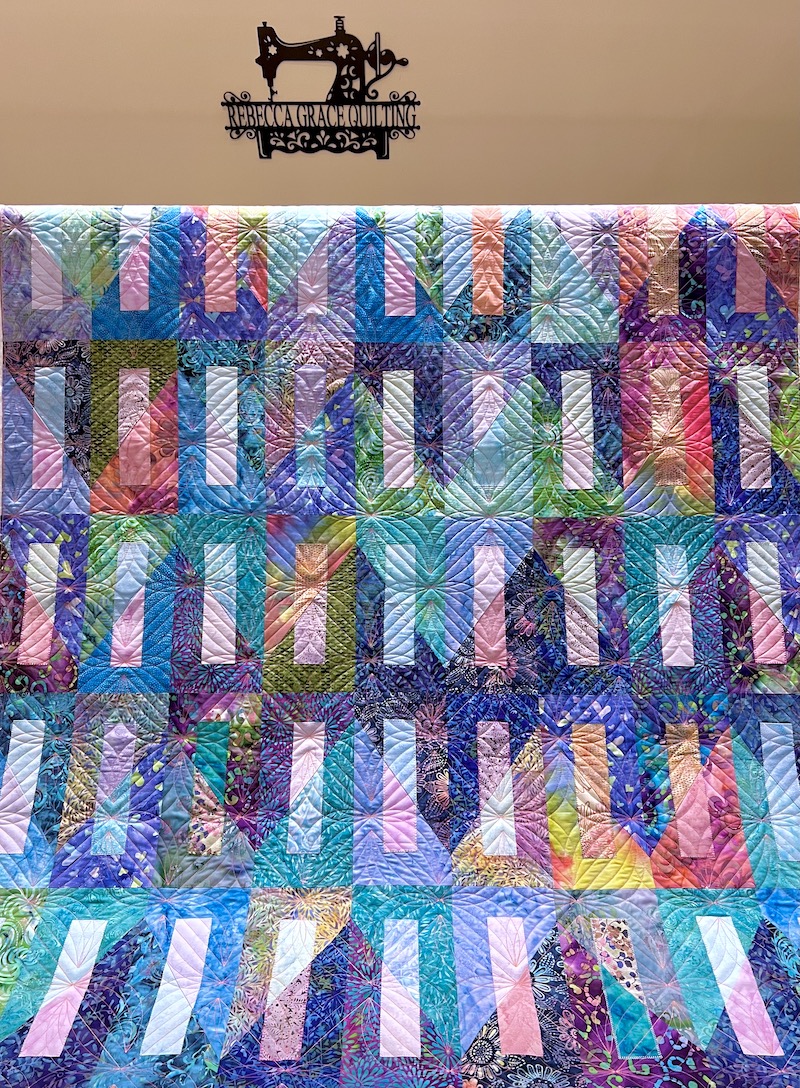
This next quilt was made by my client Debbie, who told me it was a UFO (UnFinished Object) project that she'd begun in a workshop at one point and was glad to be finally finishing and crossing off her list.  I don't know the name of the workshop or who taught it, but the the techniques involved were traditional piecing and fusible raw edge appliqué (of the skinny, lighter valued rectangular shapes).  Whereas Megan's raw edge appliqué was satin stitched "in the hoop" with an embroidery machine, Debbie's raw edge appliqué was stitched on her regular sewing machine with a blanket stitch, pivoting and turning the project under the needle at every corner.  

Debbie's 54 x 59 Rectangle Chevron UFO Quilt with Starlight E2E Quilting

Isn't this gorgeous?  Debbie's quilt was hanging in my office for a few days before she got back from vacation and was able to pick it up, everyone who saw it was oohing and aaahing over it.

So, instead of talking about just one of these quilts at a time, I thought it would be fun to share these two quilts together, both machine appliqué, both edge-to-edge quilting designs, one in a traditional floral album appliqué style and the other very contemporary and geometric.  

Sunday, April 3, 2022

Two Sweet Baby Boy Quilts for Julie

Good morning, my lovelies!  I am taking some vacation time away from my studio, but I've scheduled a few blog posts to publish while I'm gone since I have quite a few fabulous clients' quilts to share with you.  Today I want to show you two adorable baby quilts, both made by my client Julie and quilted by Yours Truly.  

Julie's 47 x 49 Blue Diamonds Quilt

Julie is one of my favorite clients to quilt for and she blesses the new moms in her life with the sweetest baby quilts that are beautiful, practical, and so very on-trend.  I'll bet the recipients of these baby quilts get asked all the time, "Where did you get that awesome quilt?"  

Her 47" x 49" diamond quilt is made up of simple strip pieced triangles alternated with plain white triangles, so the top came together fairly quickly (while the baby was still a baby!).  This is one of those "why-didn't-I-think-of-that" shower gift projects.  All you really need is a jelly roll (an assortment of 2 1/2" wide x width of fabric strips in coordinating prints) and some solid white.  And it's fabulous!  I love these bold Kaffe Fassett fabrics she used, and the high contrast, graphic prints are perfect for captivating the attention of a newborn whose vision is still developing.  If you want to make your own version of this quilt, there are plenty of Etsy sellers offering jelly roll precut strips in Kaffe Fassett prints like the ones Julie used here (this post contains affiliate links).  However, I personally have a TON of leftover strips from my pineapple log cabin project that would work well for this.  It would make a nice RSC (Rainbow Scrap Challenge) project too, don't you think?  I believe Julie used a 60 degree triangle ruler like these.

Modern Mix Quilting Detail, Stitched in Omni Thread, Color Natural White

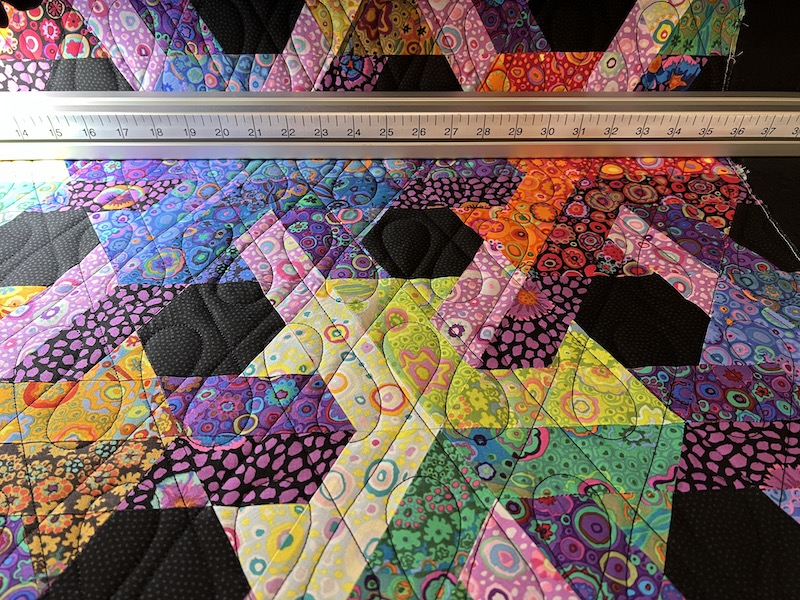
We chose Anita Shackelford's Modern Mix quilting design because it repeats many of the shapes in those Kaffe Fassett prints, and because the soft curves and spirals are such a nice counterpoint to the straight lines of the diamonds.