Showing posts with label Machine Quilting. Show all posts

Friday, March 6, 2026

Deco Bed Quilt Going Back in Time Out Following Hand Quilting Experiments

Alright, I think I'm done with the hand quilting experiments on my Deco Bed Quilt and it's time for this project to get shoved back into a closet again -- after a quick recap for the benefit of Future Rebecca.


Hand Quilting in my Grace Square Lap Hoop


After trying both ways, hand quilting with and without a hoop, I definitely prefer the hoop.  It makes it so much easier to maintain consistent tension when you pull the thread through the fabric and it definitely makes it easier to mark quilting lines, if you feel like marking them.  I have had this Grace Square Lap Hoop for over twenty years, since I used it to hand quilt a much smaller throw size quilt for my husband.  My hoop is similar to this current Grace Hoop 2 from the Grace company, except that mine doesn't have that opening in the bottom that would let you attach it to a stand.  Here's the problem: my Deco quilt is a whopping 102" x 102", the quilt top fabrics are all those beefy Kona Solid fabrics, and I used a midweight Hobbs 80/20 black batting rather than one of the lower loft battings that are tailored for hand quilters.  These factors combined to create a tremendous weight and drag that felt cumbersome to me as I was conducting my hand quilting experiments on the sofa, and I was not keen on committing to spending a hundred or more hours wrestling with this giant quilt in my lap when I could be hand stitching appliqué or English paper piecing instead.  Enormous quilts like this one are why hand quilting FRAMES are a thing!  Now, I can see how the newer version of my hoop along with the optional stand would help manage the weight of a big quilt for hand quilting, but I'm not about to invest in a whole new hoop and stand setup for hand quilting at this time.  I would not be able to recline if my hoop was attached to a floor stand, the stand would be one more thing to store or to trip over next to the sofa, and I definitely wouldn't be lugging it around as a portable project.

Here's what the hand quilting was looking like so far:


Hand Quilting in Wonderfil 12 wt Fruitti Variegated Green Thread


I'm not giving up on the idea of ever hand quilting again, just not going to slog through trying to do it on such a big quilt.  So what you see pictured above in the green areas is 12 weight, 3-ply Wonderfil variegated cotton Fruitti in a variegated green color (this post contains affiliate links).  After trying different types and sizes of hand needles, I settled on a Bohin Size 7 Embroidery needle and I used the "stab stitching" method of using my non-dominant left hand on top of the quilt to push the needle down through the quilt, then my dominant right hand beneath the quilt grabbed the needle, turned it around and guided it (blind) back up through the quilt for my left hand to grab the needle.  This was initially awkward and clumsy, but it's amazing how quickly your fingers can learn what you want them to do with repetition.  After 30 minutes or so, the motions were becoming more automatic and I was getting a lot better at poking the needle up in the right spot on the first try.

Thursday, July 6, 2023

Aurifil 40/2 vs Forty3 Cotton Quilting Thread: Mary's My Happy Place, Ramona's Escher Connected + A Sneak Peek of Mary's Mid Century Mod Quilt

Good morning and welcome to the sultry, sweaty, swampy month of July!  Today I'm sharing two beautiful but very different quilts (and giving you a glimpse of a third gorgeous quilt) that were all quilted with "forty-weight" Aurifil cotton threads.  I'll be showing you the enormous difference between forty weight TWO-ply versus forty weight THREE-ply thread.  

When comparing two spools of thread that are labeled with the same weight but different ply, the 3-ply thread is a full 50% thicker than a 2-ply thread of the same exact weight.

There's a common misconception that if two cotton threads are both labeled "forty weight," they should be approximately the same thickness and should look and behave the same when stitched out.  In reality, that weight designation only refers to the weight and thickness of a single "ply" or strand of that thread, and the cotton threads we use for piecing and for quilting are typically either 2-ply (two strands twisted together) or 3-ply (three strands twisted together).  This explains why Aurifil's popular 50/2 cotton thread (the one on the orange spool) creates less bulky seams and performs better with smaller needles and sometimes different tension settings compared to 50 weight 3-ply threads such as Mettler, Gutermann, etc.  When comparing two spools of thread that are labeled with the same weight but different ply, the 3-ply thread is a full 50% thicker than a 2-ply thread of the same exact weight.  (This post contains affiliate links).

Aurifil 40/2 (Green Spool) Natural White Blends and Disappears Across Applique

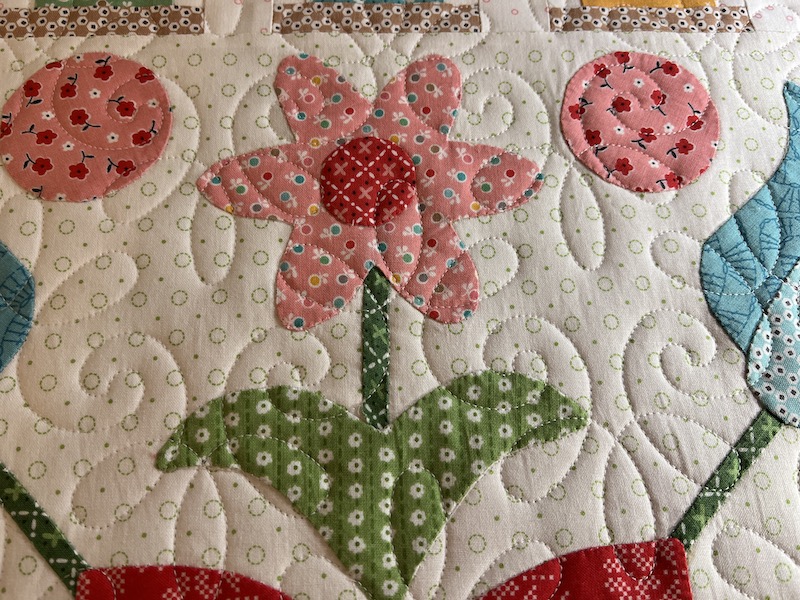
In the photo above, I've quilted the Chantilly Lace E2E design across a client's appliqué sampler quilt using Aurifil's 40/2 cotton thread in Natural White.  This is their popular 2-ply forty weight thread that comes on a green spool and is widely available in quilt shops.  Although Aurifil 40/2 is a thicker, more pronounced thread than the Aurifil 50/2 that comes on orange spools (confusingly, bigger weight numbers indicate skinnier and finer individual strands or plies), 40/2 cotton is still what I consider a lightweight blender thread for long arm quilting.  Notice how the quilting stitches take on a greenish tint where this thread crosses green fabrics, but the thread seems to be a pale pink where it's stitched across the pink petal fabric.

Aurifil Forty3 Black Stands Out Dramatically, Even Against Busy Print Fabrics

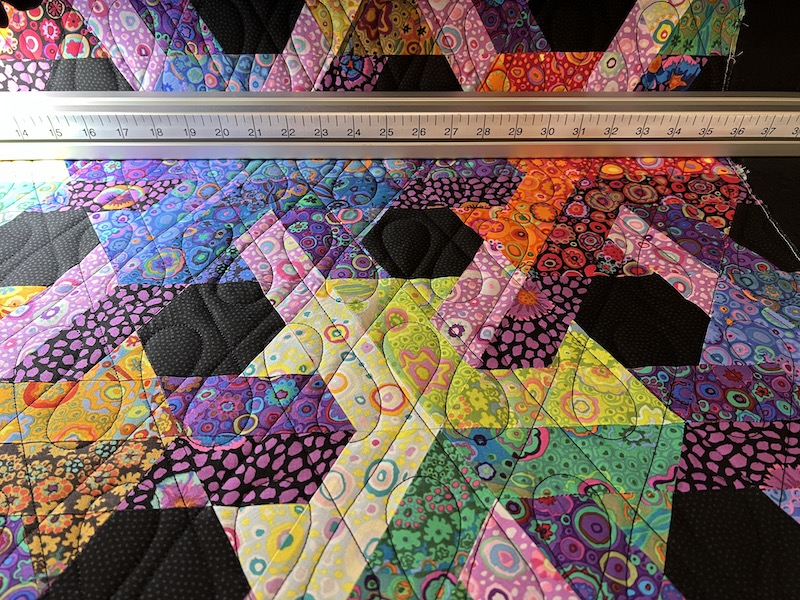
In the photo above, I've quilted the Wishbone E2E design using Aurifil's Forty3 cotton thread in Black.  Aurifil has created this thread specifically for long arm quilters, it’s only available on giant yellow cones (not spools), and it’s not as widely available at quilt shops as their 50/2 (orange spool) and 40/2 (green spool) cotton threads.

I selected Aurifil Forty3 cotton thread for Ramona’s Escher Connected quilt because busy prints like these are notorious for rendering quilting designs all but invisible and we wanted a thread that would disappear against the black background fabric but show up more dramatically against the prints.  

Thursday, July 14, 2022

Feather Quilting Dresses Up Jingle's Setting Triangles

Hey there, Quilty Folk!  I finally have some quilting progress to share on my Jingle sampler that is not invisible!

Sashing Triangles Done, Just Starting This Star Block

By the time I was done with the Drudgery That Is Ditch-Stitching, a little devil was whispering wicked things in my ear like "How much credibility would I lose as a professional longarm quilter if I paid someone else to do this for me?" and "maybe I should try some other hobby, like golf?"  Y'all, I have tried golf and it did not go well -- so it looks like I'm stuck with quilting!

It took me three days to quilt these feather designs in my setting triangles, four if you count the day I spent considering all of the bazillion possible ways I could quilt them until I narrowed it down to this one.  It's a digital block design from Anne Bright that I chose because it has formal, symmetrical feathers that complement the style of metallic Hoffman fabrics that I used in my borders and fussy cut for some of the blocks.  But it's not too traditional, either, with the staggered feather plumes curling around on themselves.  There's a touch of whimsy to these feathers that connects well with the simple appliqué shapes.  At least, that's the hope!

These Inside Corners Were Challenging!

These weird inside corner shapes (above in green and below in red) were challenging both in deciding what to quilt there, how I wanted to turn the corner with the design, and then fitting the designs into the weirdly-shaped spaces.  I was very glad when I had the fourth one stitched without messing any of them up!  

Friday, April 23, 2021

Friday Quilt Finish: Color Outside the Lines is Ta-Done at Last!


63 x 63 Color Outside the Lines, Bear Paw + Sawtooth Star Blocks

Happy Friday, y'all!  I have a quilt finish to share with you today!  I finally put the last hand stitches into the binding of my Color Outside the Lines quilt last night, wrapping up a languishing WIP (Work In Progress) that I started way back in 2014.  Woo-hoo!

I Hope You Appreciate the Azaleas...

I goaded my grouchy and reluctant husband into driving around with me to find a photo location with azaleas in the exact shade of pink as the hand dyed fabric patches in the center of my bear paw blocks.  I was like the Knights Who Say Nih from Monty Python -- "YOU MUST BRING ME A SHRUBBERY!!!!!"  Also, I told him that none of the OTHER quilters' husbands complain that their arms are sore from holding the quilt up for so long.  😏. 

Remember what this quilt top looked like before I quilted it?  Here's that Before picture again:

Thursday, April 15, 2021

Sesame Street Quilting With a Playful Floral Swirl E2E Design

Hello, hello, and happy Thursday!  Is it a "sunny day, sweeping the clouds away" where you live today?  If not, don't despair -- "I can tell you how to get, how to get to Sesame Street..."  

Seriously; by the time I finished quilting this one, I could NOT get the Sesame Street songs out of my head.  "C is for cookie, it's good enough for me. Cookie cookie cookie starts with C!"

4 inch Tumbler Quilt with Floral Swirl E2E Quilting Design

This is the second of two donation quilt tops that my mom pieced for me to quilt and donate to a local hospital pediatric patient, using the leftover Hibiscus Kona Solid background fabric from Lars's Mission Impossible graduation quilt (finished in 2019 and juried into QuiltCon Together 2021).  There was a ton of that Hibiscus purple fabric left over, and my mom kept me company in the studio while I was custom quilting Mission Impossible and she was using my AccuQuilt GO! cutter with the 4" tumbler die to cut up all of the leftover purple fabric into tumblers.  The print fabrics were pulled from my scrap bin and my stash, except for those fabulous Sesame Street prints -- I spotted those at a local quilt shop and they were a complete impulse buy.  I knew it would be great for The Charlotte Quilters Guild's Pediatric Outreach efforts.  

Tuesday, February 23, 2021

Preeti's Picket Star Quilt: Courage Like a Flower

“Deep in their roots all flowers keep the light.”              

– Theodore Roethke

Serendipity E2E Quilting Design on Preeti's Picket Star Quilt

One of the hardest things about quilting for clients is when you're working on a quilt that you are totally in LOVE with, but you can't share any pictures until after your client has a chance to share her own finished quilt on social media.  It is like having a giant box of Godiva truffles sitting on your desk, with a fan set up behind them to blow delicious chocolate aromas in your face all day, but if you eat them you will explode.  It's been AGONY, having these photos on my phone for a whole month without sharing any of them!  

Saturday, February 20, 2021

I Have a New Favorite Thread Color! Meet My New BFF, Glide Khaki

I recently had the opportunity to quilt an edge-to-edge design on a client's gloriously scrappy double four patch quilt.  My client's quilting hobby had been "dormant" for the past sixteen years, until her adult son asked her to make this quilt for him.  The most exciting thing about all of this for ME is that her fabrics are ones that I had never seen before, different from what's been available in quilt shops throughout my own quilting journey, but also different from the much older fabrics I encounter when repairing vintage and antique quilts.  However, the wide range of colors and the busy nature of the quilt top necessitated a careful thread selection.  It was Glide thread in Khaki for the win!

Don't You Love That Green/Purple/Turquoise Batik?  And the Orange/Red with Turquoise Spots?!

The thread I chose, Glide in color Khaki, is a warm beige neutral with just the barest hint of green-gold.  Glide has a bit of a sheen to it, so Khaki mimics a metallic thread against the deep navy blues and blacks, but is much less flashy (and less finicky!) than a true metallic thread.

Tuesday, August 4, 2020

LAL#1: The One With Quilter Cheryl Degan as Our Guest of Honor

Welcome to the very-first-ever Long Arm Learning Linky Party!  I'm so glad you're here, because I have a special treat for you.  Instead of just blathering on about my own quilting journey every week, I'm going to introduce my party guests to long arm quilters who are inspiring me.  Today, I'd like to introduce you all to my new friend Cheryl Degan of Austin Quilting.  After reading my interview with Cheryl, don't forget to link up YOUR machine quilting post with our linky party, at the very end of today's blog post.

"Night Sky," Pieced by Stacey Napier & Quilted by Cheryl Degan


Is that quilt not one of the most breathtaking things you've ever seen?!  Click on the picture to make it bigger, and zoom in on the matchstick quilting behind the circles and triangles, around those hexagons.  This quilt is called Night Sky and it was pieced by Stacey Napier and quilted by Cheryl Degan on her 22" Innova long arm machine.  I stumbled across this photo in one of the Facebook long arm quilters groups, reached out to Cheryl, and she graciously agreed to be interviewed for today's inaugural linky party post.  All of the quilts in today's post are the work of Cheryl Degan, and all of today's photos are used with her permission.  

Pattern: "Night Sky" by Jaybird Quilts (pattern for sale here)

Pieced by: Stacey Napier

Quilted by: Cheryl Degan, all hand-guided ruler work on her 22" Innova

Thread: White Superior Microquilter (background) & Superior Kimono Silk, Gold & Orange (stars); Microquilter in the bobbin throughout


The first things I wanted to know about this quilt were HOW did she get those circles so perfectly smooth and round, and HOW did she get such neat and tidy matchstick quilting "behind" the circles and triangles, without messing up the perfectly smooth circles when she traveled along the curved circle to get to the next straight line?  

Cheryl: Both of the threads I was using, Microquilter in the background and Kimono Silk in the stars, are really fine 100 weight threads, and that really helps because you don't get that thread buildup that makes it so obvious where you backtracked over previous lines of stitching.  I quilted the circles first, using one of my circle rulers from Teryl Loy, and then I went back and added the matchsticking afterwards.  I spaced my matchsticking by using my stitch regulator and counting the stitches between lines: 14 stitches per inch, and then counted three stitches as I travelled along the straight edge of the border before doing the next match stick line of quilting.  I  quilted all of those matchstitck lines twice, up to the circle as close as I could come without touching it, then right back down in the same needle holes so I was never traveling on the circles themselves.  

Tuesday, July 28, 2020

OMG: Spirit Song Quilting Completed + Linky Party Launching August 4th

OMG indeed, you guys!  I think this might be the very first time that I've been able to link up at the END of the month for the One Monthly Goal linky party, because this July is the first time I've actually completed the goals I set for myself by the end of the month.  I had set two goals for July, one of them a quilting goal and the other a blogging goal.

✅ My July Quilting Goal: Finish Quilting Spirit Song

  • Finish quilting borders and blue HSTs with blue thread.
  • Rethread with off white thread, either So Fine #50 weight or Bottom Line top and bottom (haven't decided yet)
  • Finalize which background fill designs I want to quilt in which areas
  • Quilt fairly dense background fills in all of the white/cream/neutral patches


  • I did end up sticking with So Fine thread in the needle and Bottom Line in the bobbin for the background quilting.  It's so exciting to finally unpin a finished quilt from the frame and flip it over to finally get a good look at the quilting design from the backing side.  I can see now why Judi Madsen prefers to use solid backing fabrics to show off her quilting!  

    Saturday, June 27, 2020

    I'm Thinking About Launching a NEW Long Arm Linky Party! Would YOU Participate?

    Good morning, my lovelies!  Before I share my custom quilting progress on my Spirit Song project, I'd love it if you'd take a second to give me feedback on an idea I've been kicking around for a new linky party.

    When I tried to link up my last quilting post with Karin's Ruler Work linky at The Quilt Yarn, I was disappointed to read that she has decided to discontinue hosting her link-up due to low participation levels.  Like many of you, I already participate in quite a few linky parties (One Monthly Goal, Design Wall Monday, To Do Tuesday, to name a few).  I love that these parties attract a wide variety of participants, from hand quilters to longarm quilters, modern to traditional, appliqué, paper piecing, and everything in between.  I have discovered lots of creative quilt bloggers and inspiration through these link-ups.  

    However, right now I'm making a concerted effort to develop my long arm quilting skills, and it would be really helpful to connect with a community of other machine quilters who are working through similar challenges.  I'm always so excited when I stumble across another long arm quilter's blog, whether it's a seasoned professional quilter, a teacher, or a hobby quilter like me.        I want to see and read about the different rulers, notions, and gadgets other quilters are experimenting with and finding useful for machine quilting, which threads and battings they are using and how they like them, and the challenges they are encountering and overcoming as they become more proficient with their machines, where they are finding the best online or in-person classes and workshops, etc.  Also, although I'm quilting with a long arm machine mounted to a frame, I realize that there is a lot of crossover between machine quilting on a frame, sit down long arm machines like the Sweet 16 or the Q20, and quilting with a domestic sewing machine.  This would be an all-inclusive linky party, open to anyone who wants to share their machine quilting, regardless of what kind of machine they're using.


    I understand that hosting a linky party is a big ongoing commitment, with even more time required in the beginning to get the word out to other quilters.  I am willing to take this on, as long as there is interest out there from other quilters -- so please answer my poll (above) to let me know how YOU feel about it.  Feel free to share any other suggestions about the linky party in the comments section, like if there's a particular day of the week you prefer, how long you think the link party should be open, etc.  Thank you!

    ...And Now, Back to the Quilt On My Frame:


    Meanwhile, custom quilting on Spirit Song is progressing, slowly but surely.  I've been pretty consistent about getting in an hour or two of quilting time most days.  I finished the first long border a few days ago (my quilt is loaded on my frame sideways, so the "top" is really one of the long sides of the quilt).  


    I know it's hard to see my quilting design against the large-scale floral print, so youmight think of all this time I'm spending quilting the borders with rulers as a wasted effort.  But it's really good practice, and it's nice to know that if I DO get a minor bobble or "whoopsie!" here or there, it's not going to jump out at anyone because it's camouflaged by the fabric print.


    Chalk Stencil Marking for String of Pearls Border

    Since I opted to use blue quilting thread in my wide outer border, I moved right into the skinny blue inner border after that.  And I'm being BRAVE -- I'm trying to quilt a "String of Pearls" in this border -- half inch circles!  In order to bolster my courage, I am marking the circles with a Full Line stencil and Quilt Pounce Stencil Chalk as a guide to help me quilt pearls that are somewhat round, consistent in size, evenly spaced, and to ensure that I end with a full circle when I come to the corner.  Interestingly (and thankfully!), the pounce chalk powder markings are lasting longer with this border design than the exact same chalk powder did for the swirly free motion designs that I was marking in the interior of the quilt.  Several possiblilities for why that might be:

    • I'm using a commercially made Full Line stencil for my String of Pearls border rather than a DIY vellum paper stencil perforated with a sewing machine needle.  This stencil has a very fine mesh with very tiny holes that allow the chalk through the stencil in more controlled amounts.
    • The pieced blocks in the interior of my quilt got a shot of starch after each and every seam was pieced and pressed open, and again as the blocks were joined together into a quilt top, whereas the blue border was only starched once after the border was attached to the quilt.  The interior of the quilt, where the starch was applied in many layers, may have filled in the nooks and crannies of the fabric weave and created a Teflon-like nonstick finish that the chalk can't settle into as well as it does with the only slightly starched border fabric.
    • I am quilting my pearl circles pretty slowly in an attempt to keep them round, and I feel like my quilting machine creates less vibration and bounce to the quilt top at this slower speed, and that may be contributing to the longevity of the chalked markings as well.
    For whatever reason, I'm very much relieved that I was able to mark the entire length of this pearl border first and then quilt it in one pass, from corner to corner, and still have clear, distinct circle marks to follow when I reached the end.  

    Experimenting With a Smaller Needle

    One more thing I changed last night: I put in a new needle -- again! -- and this time, I went with a size 3.5 Groz Beckert industrial needle rather than the 4.0 needle I had been using previously with my So Fine #50 in the needle and Bottom Line #60 in the bobbin combination.  Superior Threads has a handy reference chart on their web site that suggests optimal needle sizes for each of their threads, and size 4.0 is what they recommend for So Fine #50, but size 3.0 is recommended for the 60 weight Bottom Line thread that I'm using in the bottom, so I wanted to see what would happen if I split the difference and went down to a 3.5 needle.  It's a subtle difference, but especially when I'm checking stitch quality on the back of my quilt, the stitches do look better to me when that tiny little Bottom Line bobbin thread isn't swimming in a gigantic hole from a size 4.0 needle.  And I'm not seeing any shredding or thread breaks to my So Fine top thread, so the 3.5 needle eye seems to be plenty big enough for the So Fine thread diameter.


    Here's what my inner border of pearls looked like once I'd finished the quilting and wiped away the white chalk markings.  Disappointing, right?!  I was really nervous about trying to quilt half inch circles on a real quilt for the first time, and I thought a blending blue thread color would be my safest option.  But now that I've quilted it and it didn't come out nearly as terrible as I thought it would, I'm bummed that I can't SEE the pearls I quilted!  I wish I'd quilted them in silver metallic instead!  Ah, well -- Live and learn!  Perhaps the quilting texture will be more apparent after I wash the finished quilt.  Next time, I'll make bolder thread choices where I want my quilting to be noticed!

    I've also started quilting the two different motifs that I selected for my blue half square triangles throughout the interior of my quilt, since I'm already threaded up with blue.  One of the design is a free motion "lollipop flower" with swirly leaves (at least that's what I'm envisioning as I'm quilting it), and the other one is a simple straight line motif that has me reaching for a ruler once again.


    When I tried to quilt this little motif totally freehand, the results were not pretty.  If I was a seasoned pro, any straight line ruler would have worked fine.  I quickly realized that, as a newbie, I needed help gauging where my needle would end up in relation to the angle of my ruler edge, especially since I'm quilting lines that angle away from my seam lines.  My HandiQuilter Versa Tool came to the rescue!  This ruler has little quarter inch extension notches at either end of the straight edge, etched with a faint marking to indicate where the needle will end up if your hopping foot stitches along the straight edge of the ruler.  I've added little pieces of pink OmniGrid Glow Line Tape to the back side of those ruler extensions for even greater visibility.


    The long strip of wide, clear tape that you see along the straight edge of my ruler is super cheap, but super effective, NexCare Clear First Aid Tape that reduces unwanted slipping and sliding when I'm quilting with rulers.  You can find that at your local pharmacy, or order it on Amazon here.  

    Well, that's all I have for you today.  My To-Do for Tuesday goal is to keep plugging away at the borders and blue HSTs on my Spirit Song quilt, and hopefully progress to the final quilting stage of the off-white background fills.  I'll wrap this up with a photo of a lovely gardenia in my front yard.  I love how, when I take a picture of an all-white blossom and then blow it up BIG on my computer screen, I see so many different colors in the petals, from shades of white, cream, and gray, to ivories and butter yellows.  It reminds me of Georgia O'Keefe's flower paintings!  


    Please remember to vote in my linky party poll if you haven't already done so, and share any other thoughts you have about that in the blog comments.  Have a great day, and I hope you get to do some quilting!  I'm linking today's post up with my favorite linky parties:

    FRIDAY

    ·       Whoop Whoop Fridays at Confessions of a Fabric Addict

    ·       Finished Or Not Friday at Alycia Quilts

    ·       Off the Wall Friday at Nina Marie Sayre


    ·       Tips and Tutorials on the 22nd at: Kathleen McMusing

    SATURDAY

    ·       UFO Busting at Tish in Wonderland

    SUNDAY

    ·       Oh Scrap! at Quilting Is More Fun Than Housework

    MONDAY

    ·       Design Wall Monday at Small Quilts and Doll Quilts  

    ·       Monday Making at Love Laugh Quilt

    ·       BOMs Away Katie Mae Quilts  

    TUESDAY

    ·       Colour and Inspiration Tuesday at Clever Chameleon

    ·       To-Do Tuesday at Home Sewn By Us

    WEDNESDAY

    ·       Midweek Makers at Quilt Fabrication

    ·       Wednesday Wait Loss at The Inquiring Quilter

    THURSDAY

    ·       Needle and Thread Thursday at My Quilt Infatuation  

    ·       Free Motion Mavericks at Quilting & Learning Combo OR at Lizzie Lenard Vintage Sewing

    Saturday, June 20, 2020

    Quilter's Groove Ruler Rhapsody on a Theme of Blissful Borders

    OH MY GOSH, you guys -- I am so excited about a funny looking quilting ruler that I already owned, didn't love when I first tried it, and never expected to use again!!  I'm GIDDY!  I am about to sound like an infomercial for Quilter's Groove rulers, but I swear to you all that I have no affiliation whatsoever, I'm not making commission or earning stock dividends or anything else.  I learned about Lisa Calle's Quilter's Groove rulers for long arm quilting when I took a bunch of workshops with her at AQS Quilt Week last year.  Lisa was an awesome teacher, funny and patient, inspirational and encouraging, and I just really, REALLY like her line of rulers.


    Okay, so backing up a bit for those who may be joining me for the first time: I'm working on my Spirit Song quilt, a heavily pieced, very scrappy, and very cheerfully colored project that has no immediate purpose besides learning and exploring new techniques.  For this quilt, I've already:
    1. Designed the quilt in EQ8, with the learning objective of designing a quilt that I could cut out completely with my new Accuquilt GO! die cutting system and 8" Qube set of dies.
    2. Cut out the whole quilt, with the exclusion of the borders, using the Accuquilt GO! die cutting system.  First time using dies to cut out a quilt.
    3. Pieced the quilt top.
    4. Loaded the quilt top on my APQS Millennium long arm quilting frame, using a new-to-me batting, Quilter's Dream Cotton Select.  I fully floated the quilt top.
    5. Completed all of the SID (Stitch In the Ditch) using Superior MonoPoly invisible monofilament thread in the needle and Superior Bottom Line in the bobbin (Bottom Line is a new-to-me thread).
    6. Rolled back up to the top of the quilt, no longer floating but completely secured with SID and basting along outer edges through all three layers.  Switched to a pale peach Superior So Fine 50 weight thread in the needle, staying with Bottom Line in the bobbin.
    7. Spent hours and hours and went through several blue water soluble temporary fabric markers, marking my straight line ruler work throughout the interior of the quilt
    8. Made my own DIY vellum paper stencils and experimented with different brands of pounce chalk powder to transfer these FMQ designs to my quilt
    9. Started quilting without checking tension on the back of my quilt, was horrified when I saw the back of my quilt, and spent an hour or two carefully ripping and removing those ugly and structurally unsound stitches.  First time removing bad quilting from a real quilt, and good practice on how to do it without ripping a hole in the quilt.  Knotted and buried the loose thread tails after ripping to ensure the adjacent good stitching remained secure.
    10. Then proceeded to work my way down through the quilt again, quilting the ruler work and free motion swirly-curl designs in all of the peach/pink/orange/yellow triangles.
    I designed and cut out this quilt in October of 2019, finished piecing the top and loaded it onto my quilting frame in April of 2020, and I've been working on the custom quilting for the past two months.  So, at this point, I have about 6 months invested in this project.  I am NOT a speedy quiltmaker...

    Initially, my plan was to start quilting dense fillers in all of the white/off white/neutral background fabrics of my quilt next, but after doing zero quilting in the outer border and quite a bit of quilting in the interior of my quilt, the interior of the quilt has begun to draw up a little and the outer border was looking a little loose and ripply, as though I'd cut the border strips too long and gathered them slightly when I attached them.  I decided that I should quilt those outer borders before putting any more quilting in the interior of the quilt, to prevent distortion, pleats, or tucks from happening there.


    I like to plan quilting designs on my iPad, where I can sketch right on top of a photograph of my quilt top in full color, over and over again until I come up with something that I like.  For Spirit Song, I wanted to kind of "ghost" the triangular piecing into my outer border, but without getting too busy or complicated since this is already a very busy quilt with a bold, busy floral border.  I got the idea for my border from a quilt by Rose City Quilter that I discovered on Pinterest:


    I liked this border because it would give me some nice texture in the border, it looked fairly straightforward to quilt, and I knew the straight lines would complement the large floral print rather than fighting with it the way a feather border might.  But I had to figure out how to handle my corners.

    I wanted my quilted border triangles to align with the pieced triangles within the center of my quilt, but I have a narrow 1" blue border separating the interior of the quilt from the outer border. That meant I needed to come up with something different for the corners, because if I just stretched the last triangles out at the corners to incorporate the width of the inner border, I'd either have triangles with different angles than all the others, or triangles with their outer points chopped off by my quilt binding.  Back to the iPad, I sketched out a few different options and liked this one the best:


    Now that I knew what my border design was going to look like, I had to figure out how to actually quilt it.  One option would be to use a ruler and some kind of temporary marker to draw every single line onto my quilt top before quilting it.  Well, that wasn't happening, for a couple of reasons.  First of all, neither the purple air erasable marker nor the blue water soluble marker was going to show up on my deep purple and red border fabric.  My only options were going to be white chalk pencil or the Clover white marking pen that takes a few seconds to show up on dark fabric.  The Clover marker makes a nice, clear, very fine line on dark fabrics, but that delay between drawing a line and SEEING the line you just drew makes the marking process take even longer, especially if you need to see your previous line in order to measure where the next line should be drawn.  And the chalk pencils are annoying because either they make a thick, smudgy line or, if I try to sharpen them to a really fine point, then the point keeps snapping off and in 30 minutes I've only drawn about six lines and ground the entire pencil into shrapnel with the pencil sharpener!  But the main reason I wanted to mark my border design as minimally as possible was sheer fatigue after spending hours and hours and hours marking, quilting, and then removing marker lines all through the interior of my quilt.  

    The lines I definitely felt I needed to mark were the zigzags delineating the triangles in my border, so I'd know when to switch the direction of my quilting lines (and avoid having to do additional stitch-ripping practice on this quilt).


    My first thought was to mark these lines with one of my rotary cutting rulers, but the ones that were long enough just didn't have the 45 degree angle line etched in a convenient place.  I'm scooting my long arm machine head along the border as I'm marking so I can press down against the flat surface of my machine's ruler base to draw my lines, and the big rotary cutting ruler was knocking into my hopping foot.  But then I tried my Quilter's Groove Pro ruler, designed by master quilter and long arm quilting teacher Lisa Calle, and discovered that she put a 45 degree angle reference line in the exactly perfect spot that I needed it to be.  Brilliant!  All I had to do was eyeball the corner of the ruler to be where the triangle point landed on the inside of the blue border, line up the etched 45 degree angle line with the outer seam of my blue border, and mark a chalk line straight out to the edge, no measuring necessary.  In fact, if I was a little more confident, I probably could have used this ruler to just quilt the zigzag reference line all the way across the quilt without any marking at all.  


    Ah, buy what about those half inch spaced lines that fill in my triangles, you might ask?  Did I mark all of those lines on my border before quilting them?  Did I make little tick marks every half inch so I'd have some kind of spacing reference for aligning my ruler as I stitched all these lines?  No, I did neither of these things, because I used my Quilter's Groove ProLine 2 ruler gizmo, which is ingeniously designed for quilting perfect half inch spaced lines without doing ANY MARKING AT ALL!


    You guys, I almost SOLD this ruler because I never thought I'd use it again.  I am so glad I didn't!  This is one of the rulers that was included in the kit for the Rulers for Rookies workshop that I took with Lisa Calle at AQS Quilt Week in Paducah in 2019.  At that point I was very new to my long arm machine and had done very little quilting with rulers at all, so I was still getting the hang of how to position my hand on the ruler for the best control, how hard to press down on the ruler so it doesn't slip (but not so hard that my quilting machine can't move), etc.  And at that point, I had never marked a quilting design onto a large quilt before.  I had marked small areas for practicing on muslin practice quilts, but I did not have any sense of the hours and hours it takes to do that on a big quilt, or the additional time that it takes to remove those marked lines after quilting them.  So a ruler that eliminates the need to mark lines before quilting them didn't seem like a game changer to me at the time.  Also, as the true ruler rookie that I was when I was in that class, I was still having my ruler slip out of alignment on me periodically as I was quilting, which made my lines crooked and made me want the security of a marked line to follow on my quilt top.  (I have since then discovered the inexpensive solution of NexCare Flexible Clear first aid tape to prevent rulers from slipping).  So, I was underimpressed with the ProLine ruler concept when I first tried it, didn't understand why not having to mark the lines would be a bit deal, and didn't plan to purchase this ruler in other sizes.


    And here I am, totally in love with this ruler, sending warm fuzzies out to Lisa for designing it and for including it in her class.  After using this ruler on my border for 30 minutes last night, I had to stop quilting, go to Lisa's web site, and order the other sizes right away!

    The best way to understand how these rulers work is probably to watch one of Lisa's demo videos that you can find on her web site here.  For those who don't feel like watching a video right now, I'll do my best to explain.

    With the ProLine rulers, you are stitching inside the channel that is cut into the center of the ruler, and the width of that channel determines how far apart your lines will be spaced.  Taking the diameter of your hopping foot into account, the ProLine 1 ruler has a channel that is sized to create lines spaced 1" apart, and the ProLine 2 that I'm using in my border has a channel sized to create lines spaced 1/2" apart.  The ProLine 4 gives automatic 1/4" spacing, the ProLine 8 gives 1/8" spacing, and the ProLine 16 gives you perfect 1/16" spacing.

    If you think of that channel inside the ProLine ruler as a river, I'm always quilting my straight lines with my hopping foot riding along the left bank of my river.  Then, after I complete that line of stitching but WITHOUT moving my ruler, I quilt straight across the river (in the ditch of my border) until my hopping foot hits the right riverbank.  My needle is now exactly 1/2" away from my previous line of stitching.  Now, with my needle down and machine stopped, I slide my ProLine ruler to the right, keeping that 45 degree angle line right on my border seam, until my hopping foot hits the left river bank again.  Then I quilt the next line along the left riverbank again, repeating all the way along the border.

    It is so easy, and it worked so well!  There are alignment lines etched into this ruler for 90 degree angles, 60 degree angles, and 45 degree angles.  It worked just as well for the horizontal and vertical lines in my corner as it did for the diagonal lines in the triangles.  These rulers work for piano key borders, bead board borders, crosshatching...  And the smallest sizes, the 1/8" and 1/16" versions, are going to make short work of dense background fills.


    I selected a slightly contrasting shade of dusty blue thread, Superior So Fine in Misty Blue, for quilting my border, and now that I see how nicely the border is coming out, I'm glad that I didn't go with the purple blending thread I was considering.  Since I'm all threaded up with blue right now anyway, I might go ahead and quilt the circles in the skinny blue borders and quilt all of those little blue triangles at the same time.


    It has taken me a lot longer to write about all of this (typically!) than it took me to actually quilt this little section of the border last night, but I was so excited about it that I just had to write about it.  Especially since I'd been so nervous about quilting the borders!  And yet I'm delighted with how this is coming out!  Can't wait to get back in the studio for more quilting today!

    [By the way, when I putting in the links for this blog post, I discovered that Lisa Calle offers FREE video versions of her Rulers for Rookies class on her web site here.  There is one version of the class for quilters who are using a domestic or sit-down machine, and another version for long arm quilters.  The kit for the Rulers for Rookies class, consisting of a fabric panel and all five rulers used in the class, is available for purchase on Lisa's web site here. ]


    Before wrapping up this post, I just had to share this picture of me and my 7 1/2 month old Rottweiler puppy, Sam.  He weighs about 93 pounds now, but he's still a snuggly, cuddly lap dog!  Do you know how hard it is to breathe with a 90+ pound dog laying on your chest?!  That's why I'm not smiling in this picture!!

    I'm linking up today's post with:

    SUNDAY

    ·       Oh Scrap! at Quilting Is More Fun Than Housework

    MONDAY

    ·       Design Wall Monday at Small Quilts and Doll Quilts  

    ·       Monday Making at Love Laugh Quilt

    ·       BOMs Away Katie Mae Quilts  

    TUESDAY

    ·       Let’s Do Some Ruler Work at The Quilt Yarn